Outdoor Therapy and Emotional Strength with Stephen Hall
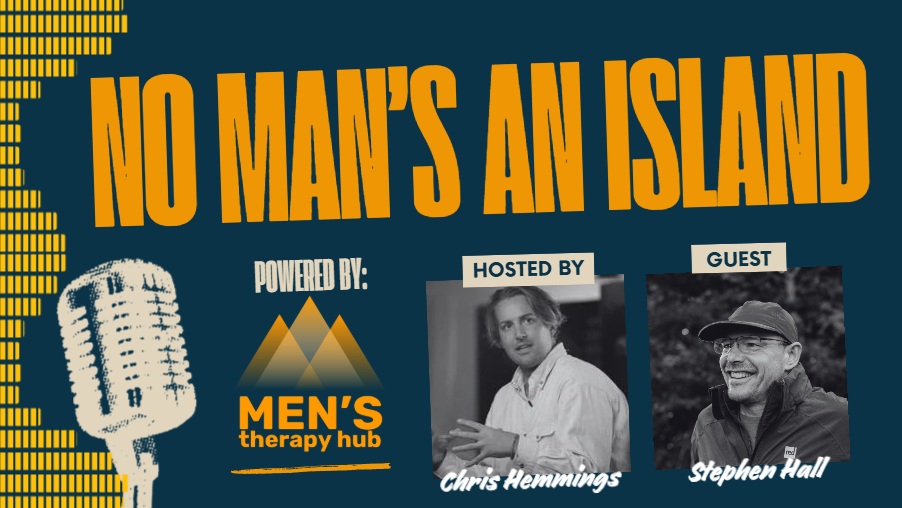
In this heartfelt episode of No Man’s an Island, Chris Hemmings speaks with Stephen Hall, founder of Stand Tall, a therapy practice helping men reconnect with emotion, body and self through outdoor therapy.
Stephen’s journey from teacher to therapist was born from personal trauma, recovery and the realisation that traditional therapy spaces often don’t meet men where they are. He shares how a lack of access to male therapists during his own mental health struggles led him to create the kind of support he wished had existed for him.
The conversation dives into the importance of male representation in therapy, the benefits of walk-and-talk sessions, and how embodying rather than suppressing emotion can transform men’s wellbeing. Together, Chris and Stephen explore how men can “stand tall” – finding strength through vulnerability, self-awareness and connection.
What we cover
- How Stephen’s time as a teacher shaped his ability to listen rather than fix
- Why rejecting compliments can actually block connection
- The importance of male therapists and representation in men’s mental health
- How childhood trauma can influence trust and openness in therapy
- The power of somatic awareness and physical presence in emotional healing
- Walk-and-talk therapy and how movement helps men open up
- Rethinking masculinity and the value of “taking up space”
- Overcoming imposter syndrome and finding courage through vulnerability
- Stephen’s vision for emotionally literate boys and male mentors in schools
Listen and watch
🎧 Listen to all episodes here: No Man’s an Island
🎧 Watch on YouTube: https://menstherapyhub.co.uk/no-mans-an-island-episode-9-with-stephen-hall/
🎧 Listen on Apple Podcasts: https://podcasts.apple.com/
🎧 Listen on Spotify: https://open.spotify.com/episode/2kOeUGTNvCUKk5KBzfJfJJ?si=1qlGeKiWQUykhxHvME00_g
Takeaways for men
- Listening without fixing can be the deepest act of compassion.
- Accepting praise allows connection rather than distance.
- Safe spaces with male therapists can be transformative for some men.
- Movement and nature can help unlock emotional expression.
- Courage isn’t the absence of fear – it’s showing up despite it.
- Teaching emotional literacy to boys builds stronger, kinder men.
Quotes to share
“You allowed me to make human mistakes and work out how to get out of them.” – Stephen Hall
“Rejecting a compliment takes something away from the person offering it.” – Stephen Hall
“Taking up space as a man isn’t arrogance – it’s healing.” – Stephen Hall
“If not you, then who?” – Stephen Hall
Resources and links
- Stand Tall Therapy – Stephen Hall
- Men’s Therapy Hub – Directory of Male Therapists
- Episode 8 – Ben West: Turning Grief into Action
- M-Path – Workshops on Masculinity and Empathy
Episode credits
Host: Chris Hemmings
Guest: Stephen Hall, founder of Stand Tall
Produced by: Men’s Therapy Hub
Original music: Raindear
TRANSCRIPT:
Chris (00:00)
Welcome to No Man’s Island, a podcast powered by Men’s Therapy Hub, which is a directory of male therapists for male clients. I’m Chris Hemings and on this episode, I’m going to be chatting with psychotherapist Stephen Hall. He’s based in the North of England and says he mainly works with men. As well as online therapy, he also offers walk and talk sessions, something I’m very much interested in discussing with him. Stephen is the first therapist who signed up to Men’s Therapy Hub. So it only feels fitting that he’s the first therapist from the site to appear on the
Stephen Hall | Stand Tall (00:31)
Thank you very much, Chris.
Chris (00:34)
The first question we ask everybody who comes on this show is, how did you end up in this space? So how did you end up becoming a therapist who’s working with men and doing all the work that you do with Stantol?
Stephen Hall | Stand Tall (00:47)
Okay, yeah. Personal experience is at the core of it. I was a teacher for over 25 years. I worked in secondary schools. I was also a housemaster, worked with boys. And I had a about 11 years ago now. And the…
bottom fell out of my world and it took me quite a while to come back from that. And that was the first time really that I started facing the trauma of what had happened in childhood. I’d very successfully buried it or thought I’d very successfully buried it and it all came back to bite me on the backside so to speak. Wind forward a few years, I…
tried setting up a couple of businesses that didn’t succeed. ⁓ I ended up in a cycle of burnout, sort three times in a row and suicidal thoughts and really struggled with that. And then COVID hit and I’d just, I’d folded business before COVID. And like many men felt quite isolated at that time and found myself on a, ⁓
⁓
in men’s group online and trying to work out what I was going to do next. At the time I was doing a lot of mentoring. I’d started doing that after I’d left teaching and I was mentoring young kids in care, mentoring veterans who’d been medically discharged from the army and the guys who was in the men’s group kept on saying to me, you need to train to be a therapist.
⁓ That’s where you need to head. And I kept on saying, no, can’t do that. ⁓
I don’t have the experience, I don’t have a psychology degree. I gave them loads of excuses as to why I couldn’t possibly be a therapist. But they kept on sending me links to training and they kept on bringing it up week after week after week and eventually I started exploring it and then went on to the Zoom call one week and said, guess what guys have applied to start my training to be a therapist.
⁓ So I started that just at the back end of COVID ⁓ and immediately recognised that there was a shortage of male therapists. I know that it’s something that you’ve talked about already, but I was ⁓ one of three in my cohort that started and the only one to complete in my starting cohort the training. ⁓
I started, when I started my placements, I was working within addiction recovery settings and so I was working predominantly with men. Recognised that a lot of the guys there also had trauma issues. The connection between addiction and trauma is well documented so it felt natural for me to specialise in working with men.
from that point forward. And so when I set up private practice, I knew that that’s the area that I wanted to work in.
Chris (04:21)
I want to ask about this drive to work with more men and I will do in a moment, but what I’m really interested in is this men’s group that you joined. What was it do you think now that you can look back that these men noticed about you or spotted about you that they weren’t telling, they weren’t deciding each other should train to be a therapist, but specifically you, Steven, you need to train. What do you think it was that they saw?
Stephen Hall | Stand Tall (04:56)
I think it was probably that I talked about what was important about the work that I’d done in the past and how important my values were to that.
So very much a values driven approach to all the stuff that I’d been doing. So for example, I’d folded my last business because I wasn’t prepared. I’d set up a healthy snacks business ⁓ and I wasn’t prepared to compromise on the values of ethical sourcing of ingredients, for example. And…
That I think was one element of it, that kind of values driven approach. I also spoke about what I’d loved about the mentoring work that I was doing and why that felt really important to be working with people one to one again and to be supporting people through important transitions in their lives. ⁓ And I think it was also possibly just the way that I was on the calls that ⁓
being there for guys, being prepared to go the extra mile to support them, ⁓ listening and not feeling that need to jump in and fix and give them the solutions to the challenges that each one was going through. I think there were various elements.
Chris (00:00)
they had spotted an ethical side of you that was important and as vital as a therapist. But the thing that really fascinates me there is, it’s spotted in you that there wasn’t a compulsion to fix when they were bringing their pain and challenges into the space. How much was that something that you think was innate in you? Because I think that’s probably one of the…
biggest challenges I’ve had to face personally becoming a therapist and becoming an emotionally literate human is when somebody brings pain and challenge, I could probably list five different things they could do differently so that that thing could change. That is very rarely what people actually want.
Stephen Hall | Stand Tall (00:46)
Yeah, yeah. I think it is something that has been innate in me. ⁓ It’s been interesting.
hearing from guys who are now in their late 20s, 30s, 40s, who I used to teach, who’ve got back in touch with me since I’ve started sort of writing on LinkedIn. And the things that they’d say to me that they recognized from my time as a teacher is that I didn’t give them all the answers, that I supported them to work things out for themselves.
that I wasn’t the sort of teacher that would say, in order to pass this exam, you have to jump through these hoops. But equally from a pastoral side, I wasn’t the one who says, right, okay, you fucked up. This is what you now need to do. I would be, you fucked up. What do you need to do about it? And I had one guy who came back to me about a year ago and said, sir, because even those in his late 30s, he still calls me sir.
So you just treated me like a human being and you allowed me to make human mistakes and then work out what I needed to do to get out of them anyway and that is probably one of the most valuable lessons I’ve ever had in my life.
Chris (02:19)
that like for you on a personal level to have somebody who is now a full grown adult come to you and of course still address you as sir? And I think I probably would with my teachers too weirdly. And meet you in that way and say thank you for creating a space for him to develop his own sense of self rather than spoon feed it to him, which is, you know, often sadly the way of the education system these days.
Stephen Hall | Stand Tall (02:30)
Yeah.
Yeah.
Yeah. I’ll be honest with you, that was really difficult for me to hear ⁓ because I’m not somebody who could take compliments at all. ⁓ I really struggled with that. So I would be very self-deprecating ⁓ and internalize it.
It’s something that I’ve learnt to do, to take from somebody else what they’re saying about me in the manner that it was intended. And that my tendency to bat it off and to minimise and to keep the barrier up is actually taking something away from them. And that’s been a really important lesson for me.
to be able to take it in and really hold it in that heart space in a way that I had learned not to do because I had put up so many barriers which prevented me from doing that.
Chris (04:03)
But know, one of the reasons that I know that I’m going to love doing this podcast is because I’m going to learn so much. And you’ve just helped me to understand something that I hadn’t considered before. Because when we talk about, as therapists, can talk about clients’ anxiety and a thing called filling in the gaps, which is where a client will be making all sorts of chaotic predictions that could happen. And even thoughts about what me as a therapist might think of them. I have to say like…
You know, you’re putting thoughts in my head and that’s, and I understand why that’s happening, but also like sometimes I make a joke and I’m like, hey, I haven’t given you permission to do that. but what you’re saying here is, is actually when somebody comes to you and tells you something positive, that very British ⁓ way of kind of rejecting compliments and dismissing and saying, no, no, no, no. I hadn’t ever considered that that’s taking something from them.
because they’re offering a gift, they’re offering an energetic gift and we are putting up that barrier and that is actually a form of rejection.
Stephen Hall | Stand Tall (05:09)
Yeah. Yeah. It’s really fascinating, isn’t it?
Chris (05:12)
Yeah, I hadn’t considered that before.
Yeah, it is. And it’s another way for us to stay disconnected from each other. And so by accepting the…
Stephen Hall | Stand Tall (05:26)
Yes. it does
is it increases the distance between us rather than reduces it. And so by taking that on board and really feeling what it is that they have to say, we’re reducing that distance and we’re increasing the connection.
Chris (05:35)
Yes.
I love that. Thank you for increasing my understanding and emotional intelligence today, Stephen. ⁓ Already this podcast has been worthwhile. I want to talk about, so you moved from that space during COVID and then you started training to be a therapist. As you say, you’re one of three on your cohort. I was one of three on mine. Usually guys are either one of one, two or three.
four is the highest number that I’ve heard so far. When you started on that course, did you already have a deep seated understanding that I want to specialize in working with men or did that grow during the course of your time when you were studying?
Stephen Hall | Stand Tall (06:45)
don’t think it was there when I first started. ⁓
I think it came.
very quickly when I started on placement. So effectively six months in to my training, I started working within an addiction recovery service that was a residential service predominantly with men. ⁓ And I remember distinctly the first time that I was
allocated a female client.
⁓
And it was after a period of time and I’d started working within a second location for the same organization. And they’d asked me to work with this lady who had been sexually abused multiple times. They’d seen me working with guys.
who had been through sexual abuse, they recognized that I was okay talking about that and exploring that in the room. But I felt, I remember taking it to my supervisor and saying, I don’t think that as a man, I should be working as a therapist with this woman.
because she’s been abused. And I feel distinctly uncomfortable talking about that history with her as a man. And my therapist came back to me and said, you’re not her abuser. And what you’re giving her is a space that is safe that shows her that not all men are abusers. And so that’s kind of flipped the script a little bit.
and me to understand that yes, I can work with women in that context. But it also reinforced for me that I felt much more comfortable working with men. And I think a lot of that comes from the fact that I wanted to provide a space that I didn’t have when I needed it.
Chris (09:12)
Which was what?
Stephen Hall | Stand Tall (09:12)
and that
felt really important. There wasn’t a male therapist. I needed to work with another man and that wasn’t offered to me. ⁓ Originally through through the NHS NHS and talking therapies and then after that when I accessed ⁓
when I was still in my old job, I accessed accessed the Bupa ⁓ policy and there wasn’t a male therapist that was offered to me. ⁓
And it wasn’t until the third therapist that I spoke to who was female, and this was a year after I ⁓ started, ⁓ a year after I came out of hospital actually, ⁓ that I was offered a female therapist who I eventually clicked with, but I hadn’t with the previous two. And so I’d rejected therapy and I closed down. ⁓
And I recognized that actually a lot of that was to do with the fact that these were two very strong women. And that’s not what I needed because that was too close to my personal history. And I closed down when being confronted with very strong, very dominant women. Because of my ⁓ own childhood history, I had a very violent…
Chris (10:25)
Yeah.
Stephen Hall | Stand Tall (10:54)
mother, a very dominant mother, a very abusive mother.
It was only because the third therapist I worked with, the female there, was a very, very gentle, very soft woman who worked in a totally different way that I started to open up and started to talk for the first time about what had gone on in my childhood. Before then, I’d just shut down that part of me altogether. And so the therapy that I’d had never really dropped to the level that it needed to. And I think had I been…
offered therapy right from the start start with a male therapist, had that been available to me, I wouldn’t have gone through the ongoing trauma that then led to suicidality, suicidality that then led to my being sectioned. I don’t think that would have happened if I’d had a male therapist early doors.
Chris (12:00)
The timeline being that you had tried a couple of therapists and before you found the one that worked for you, you had spiralled.
Stephen Hall | Stand Tall (12:10)
yeah.
Chris (12:12)
Right. It speaks so much to what I know that you’re on board with and what we’re trying to work with with men’s therapy, obviously, we’re not saying that every person needs to have a male therapist, but you are a prime example of where having the option of a male therapist and having visibility of male therapists and having a choice of male therapists could have been game changing for you.
Stephen Hall | Stand Tall (12:41)
Yes, absolutely.
And what that’s doing is recognising that, as you say, different people need different things. And what I needed was a male therapist to allow me to feel safe enough to open up. And because I think in order for kind of that post-traumatic growth to happen,
I think we need a safe, compassionate space that works for us.
And it didn’t happen for me.
And what it did was it kept me stuck. It kept me isolated. And in fact, it resulted in my spiraling much, much further down.
Chris (13:37)
then when you did start training, you had the experience of working in an addiction recovery sensor, which is obviously predominantly male. The statistics will back that up. ⁓ You will have seen, as I have seen, and you have seen subsequently, ⁓ the space that we can create as men when men find a compassionate, empathetic male ear. It can be game-changing, as it wasn’t for you.
Stephen Hall | Stand Tall (13:47)
Yeah, yeah.
Absolutely.
Absolutely.
Chris (14:08)
when you started to practice, because the question that I paused earlier was, do you mainly work with men because you seek them out, or do you mainly work with men because of the way that you create your practice that actually men come and find you?
Stephen Hall | Stand Tall (14:27)
Yeah, it’s a really interesting question actually, because when I first started out in private practice, I knew I wanted to, I thought I want to focus on trauma and addiction, because that’s where I’d done most of my training and most of my practice. I also knew at the back of my mind that I wanted to work with men. What I then found was that it was…
By referring to the practices trauma and addiction therapy, it was putting guys off because they didn’t want to be associated with the problem itself. As soon as I switched to Stand Tall,
I started to write in a different way. I started to change my focus towards the outcome of where I wanted to be. And I then found that guys started coming to me much more naturally. And so there was a shift. I do still work with female clients. I don’t specifically say I only work with men. All of my writing, so my newsletter, for example, is men’s mental health perspective.
but I get a lot of women who respond to that on LinkedIn. But I still get women coming to me, but that tends to be because they want to work outdoors, because they want to do walk and talk rather than they’re coming to me, or that they have that part of the difficulty or the challenge that they’ve got in life is in relation to men in their life, be it their…
their husbands or be it a son ⁓ or an ex-partner.
So there’s still a strong male connection there, even with the women that I do work
Chris (16:30)
And we’ll come on to talk about your outdoor work, the walk and talk therapy, because that’s something that fascinates me and I know really breaks the mold of what people consider to be traditional therapy. I’m still curious about your journey in terms of attracting male clients. mean, to those that are watching this on YouTube, you’ll be able to see.
Stephen Hall | Stand Tall (16:34)
Yeah, sure.
Chris (16:58)
But if you’re listening to the podcast, Stephen is wearing branding, nice. Stand tall is, and I forgot to actually explain what stand tall was in the introduction, which is stand tall walk tall is the name of your ⁓ therapeutic practice. And there’s a picture of a mountain and men’s therapy hope has three mountains and your mountains are representative of multiple things. am assuming, but you take clients outside and
but also you are, well tell me, is Stantol also about reminding men that it’s okay to be masculine, that it’s okay to be male because there is so much rhetoric around right now to the contrary.
Stephen Hall | Stand Tall (17:49)
Yeah, absolutely. I think that’s so important.
It’s a challenge to be everything that keeps a guy small, everything that keeps him from accessing that part of himself. It’s allowing him to recognise that he might be feeling shut down from years of pushing pain away or recognising that there’s inherent frustration or level of anger that’s there.
and allowing him to access that and to really feel it and not to feel shamed as a result of it, to not feel self-doubt and not to to allow the anxiety of that to hold him back. It’s about, right, this is me, this is who I am and this is where I want to be in my life because I want to show up
for myself, I want to show up for my son, I want to be the best version of myself. And that includes acknowledging that masculinity within me and directly challenging the toxicity that is the prevailing rhetoric that we see.
Chris (19:18)
challenging the toxicity of terminology like toxic masculinity, for example, which a lot of men are struggling with right now. A lot of young, a lot of boys in schools, there’s a new report out today ⁓ by Male Allies UK that talks about boys who they are confused as to what they are meant to be in terms of their masculinity. And how much of your work with men is
Stephen Hall | Stand Tall (19:21)
Yeah, absolutely. Yeah.
Chris (19:47)
calling in their masculine, so to speak.
Stephen Hall | Stand Tall (19:52)
think it’s inherent in the work that I do. ⁓
And I think probably because I often work in quite a somatic way to get guys to touch in with what they’re feeling in the body and what’s going on for them and where they’re holding tension, where they’re holding themselves back and to allow them to process that. So whether it be that tension that they’re holding in the shoulders or the jaw, for me, it’s always the jaw.
And that’s a reflection of me self-limiting, silencing myself. And that’s why it’s been so important for me to overcome that by putting videos out there, by appearing on podcasts. I remember a year ago, 14 months ago, saying to somebody, I will never appear on a podcast. I will never have a video on social media. It’s not happening. And all I was doing…
was limiting myself and silencing my own voice. And of course by doing that, I was projecting something to my clients as well, that it’s not okay.
to have your voice and to take up space as a man. And so that the idea of physically being able to take up space again, to be able to release those things that are holding us back. to, Stand Tall wasn’t me, wasn’t my idea. It actually came from a guy who I was on a retreat with who named me Stand Tall Hall.
Chris (21:20)
to take up space as a man.
Hmph.
Stephen Hall | Stand Tall (21:49)
because of the transition that he saw in me during the course of the weekend, that I’d gone from somebody who was making myself very, very small to taking up space. And so it was six months between him naming me Stan Toll Hall and my renaming the business as Stan Toll.
Chris (22:16)
which I have to say is beautiful story and excellent marketing. Because part of the challenge of the work that we do is trying to encourage people who are, I’m gonna say naturally reticent, but I’m not sure natural is the right word, but there is a reticence in men to come to a space like this and do the, thank you, conditioned.
Stephen Hall | Stand Tall (22:35)
Hmm.
Yeah, conditions I think more than natural.
Chris (22:45)
to be reluctant to trust a heart-to-heart space, particularly a face-to-face space, which, excellent segue, Chris, is into how the development of walking and talking therapy, because walking and talking therapy is about changing the dynamic of not looking a guy in the eye. And I know that the…
kind of psychological research for men, and I hope I’m not stealing your thunder too much here. The psychological research for men is that if you’re looking directly at a man who is distrusting of emotional spaces, it can feel first of all confronting, but also men are scanning for any sign that the person who they’re speaking to is uncomfortable. So what is it that drove you and inspired you and feels also like a natural place for you?
to walk side by side with guys and go out into nature to tell us about that work and tell us about the difference that you see in some clients, because I know it won’t work for all, but for some it can be transformative.
Stephen Hall | Stand Tall (23:54)
Yeah, yeah, absolutely. I think ⁓ to come to the first point of where does it come from? I mentioned before that I had been doing mentoring work with ⁓ young teenage boys who were in care in the care system and with veterans who had been medically discharged from the army. ⁓
As soon as I tried, I I found that when I was working with these young men, if we were side by side in the car, if we were out on a walk together, they would open up and they would go much deeper and they would feel much more comfortable in talking about what was going on for them in being vulnerable, in being honest about the shit that they got into in school, about the argument that they’d had with their carer. And that would happen.
much more naturally, excuse me, that would happen much more naturally than if, for example, we were sat having a drink and a piece of cake in a cafe. And that when we were sat opposite each other, they’d shut down and they wouldn’t talk. As soon as we then shifted again, they would start opening up. Now, when I was working with veterans,
I was working with a charity where the norm was that we would meet in a cafe. So I’m working with a guy who’s been medically discharged from the army, who’s got PTSD. I had PTSD. We’re both scanning the environment for dangers. And you’re working in a coffee shop where there are doors banging, there are coffee machine noises, there’s clattering of crockery, and there are people coming and going all the time. And…
It made it very difficult for these guys to relax, to feel safe and to start making progress. Covid hit and it was an essential service. So I was still allowed to meet these guys on a weekly basis. But we had to meet each other outdoors. And I noticed as soon as I shifted to meeting them outdoors and going for a walk, all of a sudden we started making progress.
These guys walking in the park where they could scan the environment, where they could see all around them, where they could turn quite naturally and scan for danger, could settle. And when they settled and they felt safe and they felt comfortable, they started to go deeper. They started to open up as to what was really going on for them.
Chris (26:38)
Can I also suggest that perhaps there is the element of them in the cafe, there’s a risk of being overheard out and about talking, there is much less risk of being overheard.
Stephen Hall | Stand Tall (26:48)
Course.
Yeah, absolutely. And I mean, people all often say, I can’t do walk and talk therapy because there’s a much greater risk of being overheard. ⁓ And actually, the reality is that it’s never really an issue. If you think about it, when you’re out for a walk with somebody else, are you listening into the conversations of people who are coming in the opposite direction and walking past you? No. You’re not paying any attention to them whatsoever. You might pick up the odd word, but that’s not where your focus is.
Chris (27:23)
Well yeah, you’ll get a snapshot
at best.
Stephen Hall | Stand Tall (27:24)
You might
get a snapshot of it. And the reality is also that if somebody feels uncomfortable about talking about a particular thing, then you naturally stop talking and then start talking again when it feels natural to do so. And so there’s something that actually happens quite naturally in the conversation of a walk and talk session that clients will stop, start, talk, not talk.
that there might be periods of silence, there might be periods where we stop by a style or by a gate and the conversation goes to another level. There might be a period of time where we’re walking up a hill and there’ll be no talking whatsoever and the guy will just be processing.
But it’s natural, rather than forced. It doesn’t feel that there’s a silence there that is awkward and needs to be held in a different way.
But I think there’s also something really important here to recognize about men’s brains and women’s brains, because I’m certainly not any neuroscientist, but we’ll often hear sort of generalizations about our men’s process emotions differently to women. So.
The reality is that we do have shared neurological circuits for emotion and motivation. Biologically, there’s very, very little difference between the way in which we express that. It’s the influence of those social norms that we talked about. It’s life experience that shapes how we as men feel, respond to, and express emotion differently.
I think the important thing to recognise is that men will ⁓ have a much stronger connection between the visuospatial and motor areas of the brain, which means that movement, action, task-focused ⁓ events can help men to unlock the emotional processing. Women’s coping strategies are to seek connection and emotional support.
But it’s not that men can’t express emotion, it’s just that because of what we’ve learned through these social norms and what we’ve learned through our life experiences, we need support to be able to do so differently. And so that’s where these more problem-focused, action-oriented approaches work really effectively.
because it is inherent in the way in which we process stuff.
Chris (30:26)
And that speaks to one of the big frustrations on my course. And as yet, I haven’t heard of a single course that does speak about different approaches when it comes to gender, aside from trans people, which I might add I’m fully in supportive of and men’s therapy hub already has its first trans mask therapist on, which I’m very proud of. But on my course,
Stephen Hall | Stand Tall (30:47)
Yeah. Yeah.
Chris (30:55)
There were so many eye rolls when I put my hand up and I would say, but this doesn’t feel like it would work for most guys. This approach and Jet and I spoke in the first episode a lot about the kind of blank screen, the blank slate therapist. And we’re talking here about you, you’ve been self-disclosing in this and you’ve self-disclosed on your profile about your own experiences of abuse, but also that you’re a dog owner, a paddleboard or a father, just…
giving clients a sense of who you are. But one of the biggest frustrations for me in therapy and listeners, long-term listeners to this podcast are probably going to get annoyed with me saying this so often is psychotherapeutic theory is grounded in the fact that our socialization is a big determinant of how we engage in the world and the challenges that we have in the world. So if we accept, which I don’t know.
anybody who wouldn’t accept that men and women and boys and girls are socialized differently still, if we accept that, why are we not engaging in the realities of that in our profession, in physical health profession where men still don’t go and seek support, in so many areas where men are struggling and aren’t engaging with services that are for them, but don’t feel like they’re designed for them?
At what point did you realize that traditional therapy wasn’t going to work for you first of all, but also wasn’t going to work for the sort of people you wanted to work with?
Stephen Hall | Stand Tall (32:30)
whilst I was training very early on. And in fact, yeah, it became a bit of a problem for me during the course because I kept on, I felt that I had this internal battle with what I was being asked to study and to write about and to work with in my clients and what I really felt.
And it just didn’t sit with me. And I guess it comes back to that same sort of value thing that we were talking about right at the start. And it’s like, I need to do things differently for this guy. So if I am working with somebody who is hearing voices and is struggling to sit in a room during a 12 step session, for me,
who’s been asked to be his therapist, to take him into a room to sit opposite me, to explore what’s going on with him and those voices that he’s hearing, is wrong, inherently wrong. It’s damaging for him. And so therefore I have to explore a different approach. And so when I went back to…
to the guy who was managing the service and I went, this will not work for this guy. I need to look at doing something different. He trusted in me to come back to him and say, and this is how I think it should work.
because it had to be about how do I as a human being connect with this other guy in front of me who is a human being in the way that will work for him.
And if we can’t do that, we’re doing those guys a disservice.
Chris (34:32)
if we’re being too rigid in our approach to what.
Stephen Hall | Stand Tall (34:33)
if we’re being too
rigid in our approach. And I was trained as a person-centered therapist ⁓ in a very rigidly classical methodology. And it just didn’t feel right.
Chris (34:51)
And to those listening who aren’t quite sure of what that means, in very simple terms, what is person-centered and what would you consider to be rigid about that?
Stephen Hall | Stand Tall (35:02)
What was very rigid about that approach was that the person-centered approach is that they are effectively, they are the experts. You are an expert on you. I’m not the expert as a therapist on what your experience is. And so therefore in a very rigid form, what that means is that we were told we should not be asking questions. That you don’t.
Because by asking questions, what you’re doing is imposing something upon the client rather than allowing them to express it in their own way. ⁓
Now for somebody who had been through his own trauma and for whom understand, and as a bloke, understanding why I was behaving the way in which I had, why I had held trauma in the way in which I had, for whom reading Bessel van der Koks, The Body Keeps the Score was absolutely eye-opening for me. To be told that I cannot share that with somebody else. I cannot say,
give somebody a bit of psychoeducation around what’s going on for them, to be able to ask them a question, to delve that bit deeper and to make them stop and think. To be told that that wasn’t okay just didn’t sit right for me because I felt it wasn’t working for men, it wasn’t working for me as a therapist.
Chris (36:35)
And the big challenge for me in all of it was we are told, because I was also partly person-centered trained, was we’re to sit in a room and we’re not to be direct. And yet often you and I will be working together with clients who, and this is no slight on them because it’s not their fault. Many of whom,
I say sometimes they open their emotional toolbox and it’s empty. When I opened my emotional toolbox after my death of my dad, I filled it with cocaine, which worked for a short amount of time, right? But actually once the cocaine had run out or my ability to take it had run out, the toolbox was empty. So to sit there and say, you have to figure that out, I think it’s almost unfair on them. It’s cruel in a sense and can actually…
create a level of shame that they’re already feeling in the space because they’re being asked to do something that is so against what their whole life’s training has been up until this point.
Stephen Hall | Stand Tall (37:46)
Yeah, absolutely. And that’s what’s so important to recognise is that we’re not giving somebody the answer. We’re not telling them that they have to do this or they have to behave in this way. We’re showing them that we’re opening up the possibility that there is more, that you can find this language.
have it, you might not have it at the moment, you might not have this understanding, you might not recognise what it is that’s going on there, but let’s look at that, let’s start to access that. So what is it that you, where do you feel it when you feel that, when… ⁓
When you feel that you have been challenged or questioned or shut down, where does that sit with you? What’s going on? Let’s access what it is that you’re feeling. And okay, I’m feeling it in my gut. My gut’s really starting to churn. Right, okay, what’s that like?
or I feel a tightness in my chest. Okay, right, let’s breathe into that space. Let’s just acknowledge that feeling, that tightness is there. You don’t need to shut it down. You don’t need to close off from it because that’s what we might inherently do. We might go, ⁓ now that’s uncomfortable. I don’t want to feel that. I don’t want to think that. Shut it down. Let’s just give it some space. And then we can talk about it.
giving guys permission to feel what is real for them is so important.
Chris (39:39)
Did you find a male therapist in the end?
Stephen Hall | Stand Tall (39:42)
I did, but not until I started doing my training. So as part of the training, we had to have a certain number of hours of therapy. ⁓ And it was then that I found a male therapist.
Chris (39:46)
Okay.
for you, what would you say? Because one of the questions we ask every guest on this podcast is, did you go to therapy? And I know the answer to you is obviously yes. The follow up question is they say yes, is well, what was it like for you to start that process? So for you, because you’ve explained the initial process, what was it like for you when the key started to fit in the lock and started to open and you began to be able to trust in your own ability to
understand your own experiences and speak them and realize that, I have all this vocabulary that I didn’t that I know I knew what all these words meant, but I could never point them in my own direction. What was that experience like for you? Because we get to witness it with clients all the time. And it’s one of the biggest privileges I’ll ever have. I told a client two days ago that sitting with him to do this work is one of the biggest privileges of my life. It’s incredible. What was it like for you?
when things started to come together in the therapeutic space.
Stephen Hall | Stand Tall (41:14)
I
It totally transformed the way in which I understood.
that younger part of me that I had closed off from, I had dissociated from. It allowed me to feel…
closeness to that young boy because for the first time I was really given permission to…
access those emotions.
I felt like I was sitting with another man who…
got what it was like to be a father who wanted to be different as a father.
⁓
somebody with whom I could feel vulnerable without feeling shame.
and to sit in front of somebody who wasn’t going to judge me, who was just going to accept me for who I was.
That was really important.
Chris (43:08)
which is probably one of the most common experiences I have with clients. After we do four sessions, I have a check-in. And one of the most common things that they will say is, I have never sat in a space and talked about myself and felt like I wasn’t being judged.
and just how incredibly opening that can be for somebody. And I obviously say, well, I’m specifically trained not to judge you. I don’t say this to clients, but you can be a member of the fucking KKK and you’ll come into a session and I’m not gonna judge you for it. I’m gonna find out why, because nobody was born racist. I’m gonna discover what has happened to you along the way that’s made you feel this way.
Stephen Hall | Stand Tall (43:53)
Yeah. Yeah.
Chris (44:00)
And that is just beautiful. There’s a therapeutic term for those who aren’t trained therapists that are listening called unconditional positive regard. And when I learned that the sense of anybody can come and sit in front of you and it is your duty to make them feel completely unjudged, it made so much sense as to how powerful that trait and that technique can be.
Stephen Hall | Stand Tall (44:25)
yeah.
Yeah, absolutely. And I recognized quite how powerful it was with one of the clients in addiction recovery, who I went out to meet him in reception and I shook his hand and I called him by name. And that was how we started our sessions. ⁓
How we ended our sessions, our final session together after about a year of working together, was his telling me that he already had a rope ready and a noose ready for when he returned back to his room at the end of that day of our first session. So his intention was that he was gonna leave that day and he was going to take his own life.
And I knew nothing about that. He didn’t say anything about it during our whole year of therapy until the end. And when we came back to it and I said, what was it that made the difference? Why didn’t you do that? He said, you came out, you shook my hand and you called me by name. And you didn’t judge me as a junkie. You didn’t judge me as a loser. You didn’t judge me as an ex-convict. You just treated me like a man.
And you never know what action it is that you’re going to do that will make the difference for that individual. For him, it was shaking his hand.
Chris (46:08)
being seen as a person.
Stephen Hall | Stand Tall (46:10)
and
being seen as a person.
Chris (46:15)
It is beautiful, the work that we do. And you said at the start, ⁓ when you were first being tempted or semi-coerced by your people on your men’s group, as I was semi-coerced by Annie, as people will have heard in the episode where Jet interviews me into becoming a therapist, but it sounds like you had a similar moment of who the fuck am I to think I can be a therapist?
And I ask you this question. Yeah, well, you’ve beaten me to it because on LinkedIn recently, I have seen you have been writing a lot about imposter syndrome. And I ask you this because what gives me and you the right to say, we can create a space for you to come and heal? What gives me the right to say,
Stephen Hall | Stand Tall (46:44)
Had a similar moment, I have it all the time.
Yes. Yeah.
Chris (47:12)
I think men’s therapy hope is a good idea. Maybe I should launch a podcast. I don’t know. What gives you the right to start posting even though you’ve specifically said to your mate, I’m not gonna post ever on social media. And of course we don’t need the right to do anything. We have the right as a human. can try things out and we can do things and we can take the risks to make mistakes. Tell me a little bit about your imposter syndrome.
And also I think, because it’s something that a lot of people experience, how did you reckon with it? I’m not going to say how did you cure it because I don’t think that’s possible, but how did you begin to get a handle on it so that you could be here today and speak on a podcast? So you could, so I did find you because you were present on social media and we were in a meeting of men doing men’s work together and you were vocal, not as vocal as me, cause I don’t show up, but you know.
You’re here doing it. How do you reckon with that imposter syndrome?
Stephen Hall | Stand Tall (48:18)
⁓
friend of mine.
said to me at the weekend, if not you, then who? And I think it’s…
It’s recognising that I am a man. I am trained as a therapist. I have my own experience of trauma. I know what it’s like to have gone there. I know what it’s like to have been shut down.
I know what it’s like to have held myself back and I know what it’s been like to kind of, for that to then come out in all sorts of other unhelpful ways and unhealthy ways.
I know what it’s like to be standing at the very edge of a precipice and then to make a decision not to step off it, but to step back.
And I see around me in the world so many guys who have not been shown how to
how to express themselves, how to challenge those stigmas, judgements, ⁓ the guilt, the shame that holds them back.
And I’ve gone there and I’ve been heard. I’ve been given space. I’ve been given tools. ⁓ People have opened that door for me.
⁓ People have helped me to overcome immense challenges.
18 months ago, I could not sit with my back to a door without feeling in danger and hypervigilant. On my course, had to, at one stage, I had to ask if we could move rooms because there were two doors, one on either side, and I couldn’t keep an eye on both of them in order to feel safe. And so I asked if we could shift rooms so that I could sit opposite a door.
so that I could feel safe.
Chris (51:07)
incredibly
brave of you to actually dare to do that in front of people.
Stephen Hall | Stand Tall (51:13)
Yep. And by that stage, I guess I’d already done a lot of work on myself. So I recognized that that was a challenge that I had. And I was in a space where I wanted to move forward. So I was recognizing someone that was holding me back and I wanted to push through that, but I also didn’t know how to overcome that challenge. And ironically, I remember having one tutor who tried to force me to sit with my back to a door.
in order to overcome that challenge, which of course didn’t work at all and I ran for the hills. But I guess because I have…
I’ve experienced what it’s like and I’ve been given a route out through that. And so therefore, I have to.
I don’t have to. Maybe that’s where part of this imposter thing comes from is that part of me goes, I have to do this. then the part of me goes, no, no, no, you can’t do it because who are you to do that? Yes, we’re always questioning ourselves. I’m choosing to. I’m choosing to do something.
Chris (52:14)
Yes.
But you’re choosing to now. You are.
Stephen Hall | Stand Tall (52:34)
which helps other guys.
Chris (52:34)
⁓ As far as I see
it from what you’ve said, you are calling in that part of yourself to say, okay, I overcame this. So I can use the learning and the feeling and the drive to say, well, if I can overcome that, then I can overcome my fear of posting a video on social media. And that is not to underestimate the challenge of posting on social media, but that is to hype up just how big and
difficult and challenging that work is. And that’s where Stephen, I come back to calling in the masculine to say, that’s fucking courage. That’s courage on a level that most guys would run into a hundred burning buildings before daring to do what you had to do. And I don’t judge them for it. That is part of our socialization.
Stephen Hall | Stand Tall (53:24)
Absolutely. It’s what Brandy Brown calls vulnerability courage, doesn’t she?
And to challenge that idea of the vulnerability of what we do when we’re posting on social media, what you do when you stepped into this space and created this platform which calls men to support other men. When you’re bringing other men onto this podcast to speak, you are calling forward that vulnerability.
and recognising that that actually takes huge courage.
in order to do so. And the more times we do it, the more we are overcoming those things which make us small. I remember going onto a podcast not long ago and having a massive panic attack before I started it.
Chris (54:10)
minutes.
Stephen Hall | Stand Tall (54:26)
And I didn’t feel that today.
Chris (54:30)
Because you’re doing the reps, you’re practicing and it’s the only thing that we can do. It’s what I tell my clients and it’s what you pointed out that we spoke to, Jett and I spoke about in the first episode. It’s like you, you can talk and talk and talk in a therapy setting, but you have to go out and implement it outside the room. And that’s what you’re doing. You know, you’re taking that knowledge of yourself and you’re saying, I’m not that person I was when I was a kid anymore. I’m an adult and I get to choose. And is it still terrifying? Yes.
But do I have agency and autonomy now? Yes. And both of those things can be true at the same time, and they are.
Stephen Hall | Stand Tall (55:08)
Yeah, absolutely.
Chris (55:10)
Just to finish, and I really admire that you came on here today. It would have been okay if you did have a panic attack beforehand and came on here and cancelled just to be very clear, but I’m glad that you didn’t. So well done for doing that. I didn’t know that about you. So that’s extra impressive that you’re coming on here and being so open and eloquent. Final question we ask every guest on this show.
I am going to give you the keys to the vault so you have access to unlimited funds.
What are you going to do that is going to impact or change the world in the way that you would most want it to change?
Stephen Hall | Stand Tall (55:59)
think this is where my background as a teacher comes in from having worked with boys in school. ⁓
We need emotionally literate young men who are confident in their own skin. And there’s amazing work that’s being done in schools by the likes of the Boys to Men program and Progressive Masculinity. And empath, and there are so many other organizations that are doing great work within schools.
Chris (56:30)
an empath.
Stephen Hall | Stand Tall (56:41)
So I think we should be expanding that because what I saw at the Boys Impact Conference earlier in the year, there’s a Lost Boys report that came out in March, there’s a Boys in School report. There’s a huge risk to our young men and to society unless something is done. 81 % of boys don’t feel that they have enough space to be a boy. Over 70 % don’t have more than one person.
who they feel knows them really well. Half of boys find that the online world is a more rewarding place to be than the real one. And as a result, many are turning to chat bots for emotional support and friendship. And as you mentioned earlier, so many don’t know what it means to be masculine, what it means to be a man.
anymore or how to express it without it coming across as being toxic. So what I would do is I would expand those programs so that every teenage boy in every school up and down the country has got access to a program that helps them to understand what it’s like to be a man in today’s world. But then what I would do is I would take it a stage further and I would ensure that there’s a long-term one-on-one mentoring program for
all boys where they can make real connections with real men who are going to help them to navigate the challenges of this world and that’s where I’d want to spend the money because then it means that they can ask the questions that they need to ask and they can be heard as boys rather than feeling that they need to silence their own voices.
Chris (58:30)
It’s so similar to my desire. I made the joke about empath because that’s the organization that I set up that does that work. if I, I, in my answer to Jet, on my episode when he interviewed me, I want mentors in schools, male and female, but I want male mentors in schools. I want youth centers back open and I want counselors who are there. And I want good, emotionally literate, fun.
guys who can connect with these boys and give them the guidance that they are so desperate for. So I love that Stephen and I’m really impressed with your way of being and the way that you are operating in this space and the courage that I didn’t know that it took for you to do this. So kudos for that. If people want to find you, if people want to work with you, if people, sorry.
If people want to disagree with you, which I’m sure they will do at times, where do they find you? How do they find you? How do they get in touch with you?
Stephen Hall | Stand Tall (59:29)
absolutely.
My website is stanntour.org.uk but I spend a lot of time on LinkedIn. They can find me on there. Stephen Hall Therapist. That’s where I’ve got my newsletter which I publish on a weekly basis but also I am on LinkedIn as she said stan tour walk tour.
Chris (1:00:00)
Great. Thank you for the work that you’re doing. Thank you for giving us your time. Thank you for being the first therapist to sign up to Men’s Therapy Hub. ⁓ It’s an honor to have you on there and I look forward to us having many more conversations in the future.
Stephen Hall | Stand Tall (1:00:16)
Thank you, Chris. It’s an absolute privilege to be here.