Shame, Depression and Recovery with George Bell
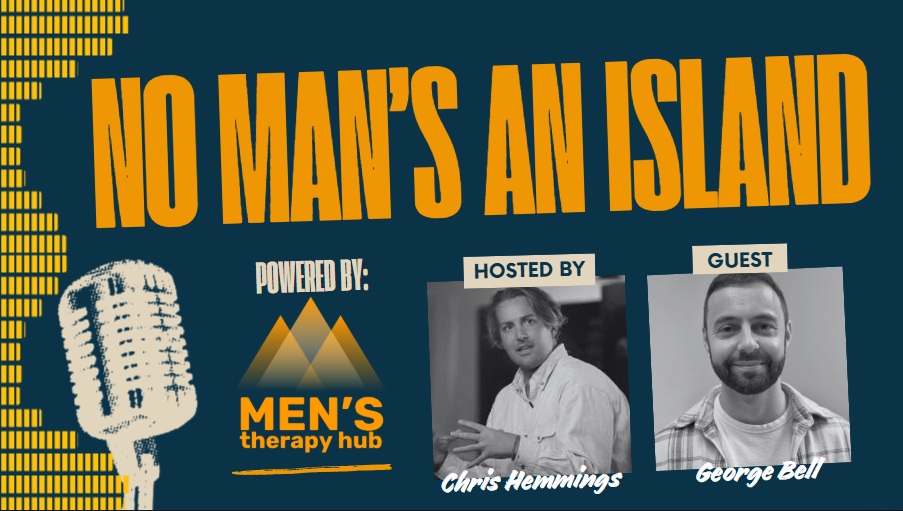
In this insightful episode of No Man’s an Island, Chris Hemmings speaks with George Bell – writer, speaker and co-founder of Jack, a publication dedicated to honest writing about men’s lives. George is also the author of Be A Man About It: Building a Healthier Idea of Masculinity, out in January 2026.
George shares his personal story of battling depression, anxiety and suicidal thoughts in his early twenties, a period where he felt trapped between silence and despair. With honesty and clarity, he reflects on how societal expectations of men shaped his struggle and how therapy, language and compassion helped him find a “third door” – a way out that didn’t involve self-destruction or emotional shutdown.
Together, Chris and George unpack the weight of shame, emotional suppression and learned stoicism that keep so many men isolated. They explore how culture, upbringing and media teach boys to equate strength with silence, and why vulnerability is actually a deeper form of courage. This conversation challenges old scripts about manhood and invites men to start speaking, listening and healing.
What we cover
- George’s experience of depression and suicidal thoughts in his twenties
- How cultural conditioning and masculine pride kept him silent
- The “third door” – finding hope through therapy and connection
- Why shame and blame keep men trapped in cycles of silence
- The power of language in reshaping emotional awareness
- How therapy helped George rebuild his sense of self and purpose
- The balance between accountability and compassion in men’s work
- What his upcoming book Be A Man About It aims to change
- Why men and women must work together to rewrite the narrative
Listen and watch
🎧 Listen to all episodes here: No Man’s an Island
🎧 Watch on YouTube
🎧 Listen on Apple Podcasts
🎧 Listen on Spotify
Takeaways for men
- Silence protects no one – it only prolongs pain.
- Shame thrives in isolation; it weakens when we speak it aloud.
- Therapy isn’t weakness – it’s an act of courage and self-respect.
- Masculinity can be redefined to include empathy, honesty and care.
- Change starts small – one conversation, one act of compassion at a time.
Quotes to share
“I almost traded my life to preserve masculine pride – for who and to what end?” – George Bell
“The third door was always there, but I couldn’t see it until someone showed me.” – George Bell
“Shame keeps men quiet. Compassion helps them speak.” – George Bell
“We have to build a version of masculinity that allows us to feel, not just function.” – George Bell
Resources and links
Episode credits
Host: Chris Hemmings
Guest: George Bell
Produced by: Men’s Therapy Hub
Music: Raindear
Transcript:
Chris (00:00)
Welcome to No Man’s An Island, a podcast powered by Men’s Therapy Hub. That’s a directory of male therapists for male clients. I’m Chris Hemings and on this episode, I’m gonna be talking to George Bell. George is the author of the forthcoming book, Be A Man About It, Building A Healthier Idea of Masculinity. It explores how modern expectations of manhood shape the way men think, feel and relate to others. It comes out in January 26.
He’s also the co-founder of Jack, which is a publication dedicated to honest writing about men’s lives, bringing together essays, interviews, and cultural commentary, speaking to the realities that many men experience, but rarely say out loud. Hey, George.
George (00:38)
Hey Chris, that was a great intro as well, thank you.
Chris (00:40)
Thanks very much. Well, we’re trying to do something different on this podcast where we do the intro so that the guests can hear it. Because a lot of podcasts, you’ll be introduced kind of like off mic. But this way you can say, actually, that’s a load of bullshit. That’s not me at all. And sounds like we got it right this time. So that’s good.
George (00:57)
Yeah,
also, it’s also, you know, you don’t always like introducing yourself, right? ⁓ I’ve got a book come out and I do this. It’s nice if someone else can say it for me.
Chris (01:05)
Agreed,
agreed. First question we ask every guest on this podcast is, how did you get into this space? So for you it is, how did you get into writing and thinking about masculinity?
George (01:18)
Do want the short answer or the long answer? Let’s do it then, let’s go straight there. I think the short version of it, and I’ll then expand, is that about 10 years ago, I didn’t want to be here anymore. I wanted to take my own life. That’s kind of the headline really. And I think to expand on that, I was around 21, so I was my early 20s. I’d just come out of university, just graduated.
Chris (01:20)
Now we’re on a podcast. Long answer is good.
George (01:47)
you know, sort of dubbed the best years of your life. And I was, I was then going into the twenties, which is sort of unofficially dubbed the next best years of your life, where you go out into big wide world and, get a job, money, all the rest of it. But I was all out at sea by myself. That’s it felt just in turmoil. was, I didn’t know at the time, but I was depressed and anxious and ⁓ yeah, I didn’t, I didn’t have that vocabulary at the time. So I didn’t realize it was mental health issues.
I just, the only way I could describe it to myself was that I felt, I felt weird. That was, that was my language for it. But I think the point being I was clearly massively off kilter with myself. But the reason I’ve ended up here is that I didn’t talk about any of that. I just, and I didn’t deal with it. I just ignored it. I assumed it was something that would, that would fix itself. you know, obviously knowing what I know now you ignore.
Chris (02:26)
Hmm.
George (02:43)
your emotions, you can always experiences, they don’t just go away. They, you know, they can often do get worse. So things progressively got worse for me over, well, quite quickly, actually, over a few period of a few months. And I ended up in this place of, you know, deep suicidal ideation, really, it was, it was, it was the only thing I was thinking about all day, you know, the first thing I thought about when I wake up, last thing I thought about when went to bed, sleep was was kind of
a relief. was solace and then back on the hamster of the next day. And that was just, that was my life really for a few months. And yeah, obviously horrendous, absolutely horrendous kind of being in that place of fighting your own mind. But again, I did not talk about it. had a girlfriend at the time, had a loving family, great set of mates that I’m still really close with now. And none of them knew what was going on.
on the outside.
Chris (03:40)
And why not?
Why not? What was it that was going on for you that you can now see that made you feel maybe forced is too strong a word, but maybe not to keep it all in and not share?
George (03:55)
cause I was a man, cause I am a man. And, you know, the, masculine code that I’d sort of learned from, you know, family, friends, playgrounds, cultural mediums was that men don’t talk about this stuff. Men don’t talk about weakness. It’s you’re, you’re kind of just fine all the time. You’re smiling, you’re strong. That’s, that’s how men are meant to be. There’s a, there’s a good comedy sketch from a comedian called Bill Burr who says that men are allowed to be one of two things. They can be mad or they can be fine.
And that’s, those are basically the two emotions we’ve given to men. You can be angry and that’s often expected with men. Anything else is just fine. And I think that’s, that’s the realm I was in. And it’s, it’s really, really strange looking back because, you know, I wasn’t, I wasn’t kind of in conversation with myself saying, do I talk? Do I not? If I do, who do I go to? What might the responses be?
None of that happened. It was just like a complete non-starter around talking. I didn’t even entertain the thought to myself of maybe I could talk. It was so deeply ingrained in me that we just don’t talk about it. That for me, my only options were basically get better or take my own life. And I have to do that in isolation with myself. And, you know, at the time that made so much logical sense to me, even though, you know, I was in a place of, you know, not really dealing with necessarily logical thoughts.
Chris (05:07)
Hmm.
George (05:19)
Whereas I think, you looking back now, it almost just seems crazy repeating that, really the equation was that I was essentially almost willing to trade my own life to preserve this sort of notion of masculine pride. But for who and to what end? I wouldn’t have gotten an award for doing that. So I think, you know, that is really why I’m here today. There’s a whole journey with all of that, you therapy and
Chris (05:35)
Hmm.
George (05:49)
and working on the mental health issue specifically. But a huge part of that journey was deconstructing and then rebuilding my sense of masculinity and what it means to be a man because, you know, that got me to the place that ultimately, you know, I deciding to maybe take my own life. And I that’s why I’m so passionate about this work now, because, you know, obviously I’m super grateful I’ve come through that. But I know a lot of men that are still struggling with that. And I’m sure, you see it every day in your work as well.
Chris (06:18)
and a lot of men who don’t make it as well. A lot, a lot, a lot, too many. There’s a couple of things there that I’m interested in. Of course, you’ve said that you’ve been to therapy, so I’m gonna put a pin in that, because we’ll come back to that, given that this is no man’s an island powered by men’s therapy hub. But the thing that is most interesting to me there was, it’s kind of twofold. First of all, you said, well, you weren’t gonna get an award. Nobody was actively explicitly encouraging you to stay silent.
to say the longer you stay silent, the more manly you’re going to be. But it is this kind of internalized understanding of that. But you use this term weakness. You didn’t want to show weakness. Where had you learned that to express yourself emotionally was to show weakness?
George (07:10)
Yeah, it’s funny. mean, you there’s not, it’s not like I can pinpoint a, you know, a single lesson I had in, you know, year four school where a teacher said that it’s unfortunately it’s not, it’s not as clear as that. And I think so much of the way that we are now is from stuff that we picked up probably at a time when we, can’t even remember. We were so young, we were forming and you, know, you just pick up on things around you that, that kind of form themselves as beliefs, even if they’re not memories now. So
I can’t pinpoint a specific thing, but what I can say is, in the period when I grew up, imagine it was similar for you, we were just in a culture of traditional masculinity, really, where it was just sort of culturally assumed that men don’t really talk about this stuff. And sometimes that might have been kind of overt displays of if a man does open up, he would get criticized, or it might have been subtle. The films at the time, always men looked a certain way, very kind of muscular.
there was rarely, or if ever, kind of emotional vulnerability in these films, or if it is, it had to be kind of wrapped up in traditional masculinity. like, know, Gladiator, for example, one of my favorite films, there is emotion in that film and there’s clear grief, but it’s wrapped up in this much wider story of war and battles and a fight to the death and all that kind of stuff. So here is Journey, yeah, here is Journey, but it’s always…
Chris (08:31)
of the hero’s journey.
George (08:36)
it’s always a hero, know, it’s kind of one hero that we grew up with or, know, like you’re James Bond’s just always gets the woman ridiculously charming, can do things like stunts that no other man can do, never loses, no real weakness there. If it does, it changes very quickly. I mean, that’s the culture that I grew up in and there would have been things that my parents said, you know, I absolutely loved them to death, but
there would have been things they said around manning up, toughing up, just get over it. There would have been stuff like that on the playground. Kids were bullied if they cried. I think that was the culture that we were swimming in and grew up in. you know, yeah, it’s not like someone sat me down and said, never talk about your emotions, but that was all I saw. All the signals everywhere, home, school, know, billboards, those are the signals. So such a…
deep belief, you know, when I, when I said that I wasn’t even considering, do I open up? Do I not? Because what we’re dealing with is such deep rooted beliefs. So, you know, so deeply ingrained.
Chris (09:45)
Yeah. Which is what is so interesting about the way that we internalize this as men. Because like you said, it isn’t necessarily explicit. There isn’t a booklet that we are given at eight years old. But what it is, it is the constant undercutting and undermining of the emotional self. And for you, you are a
I’m say a fantastic example, it’s a weird word to use, of exactly this, where you didn’t feel like there was any, there were two doors to go through. There was continue to be completely suppressed and miserable, or make the ultimate decision to end your life. So for many years of your life, you had only two options. When did a third option start to come into view for you?
George (10:46)
It’s a great question. think a really, powerful one, which is a powerful part of the story. And, know, I think what’s funny is that third option was always there, right? That there was always another door there, which was full of love and support and help and solution. I couldn’t see it. So, you know, you’re so right. There was, for me, there was two doors, but I was so narrow minded. If I just broadened my view, broadened my horizon, I would have seen the third door, you know, there on the right or the left or whatever.
Chris (10:58)
but you couldn’t see it.
Can I just stop you there because you call yourself narrow-minded and one of the big parts of the work that I’m trying to do with men in my therapy practice and just generally with this is to try to move away from self-blame and shame. Because even to call yourself narrow-minded, there’s an element of self-criticism in that to which I would say, well, maybe you could use a different way of phrasing that. It’s not that you were narrow-minded, it’s that you hadn’t been shown that there was a third door.
The third door was behind an invisibility cloak, right? So I don’t know, to me there’s just a little hint of blaming yourself there when actually this is not your fault that you couldn’t see the third door.
George (11:51)
You’re absolutely bang on. Actually, you I feel like I’m getting a free therapy session here. So I appreciate it. But no, you’re absolutely bang on. And I think it’s a small thing and a subtle thing, but it is an important thing because so much of what we’re dealing with here is language. So, you know, I think you are very, very right. And I think when I say that I was narrow minded, that’s what I’m kind of trying to say there is I’m not trying to be hard on myself. I’m trying to say that, you know, I was narrow minded almost because I was forced to be narrow minded by the narrow lessons that I’d been taught.
Chris (12:20)
Yeah, okay.
George (12:21)
Culturally, so it was like, you society had put the blinkers on me. Therefore I was narrowing my vision But you you are you are right I think we have to we have to strip away the kind of shame from this because that’s that’s half the battle you know, had I had these had these blinkers on and The thing that changed is so I had a girlfriend at the time who? basically Called me out on abnormal behavior. She sort of has a throwaway comment
She just said to me something like, you know, you’re so cold and you’re so distant sometimes. And that was a bit of a slap to the face. It was a bit of a wake up call. Yeah. I mean, it completely fair, like so fair from her, but it was a slap to the face because that’s not who I believe I am. sort of, you know, I pride myself on maybe being a warmer character. And I think up until that point, I believe that I was
Chris (13:01)
Yeah, ouch.
George (13:19)
wearing my two masks really, really well that, you know, I was going through this turmoil, but I was doing that on my own and to everyone else. just switched the mask out, big smile and kind of staying present with people. And I think that was a slap to the face because one, was, she was basically saying, you you’re someone, you know, you’re this person that I knew wasn’t me. And I think two, it was clear that the masks were, you know, the two worlds are almost colliding and I can’t remember exactly what I said.
but I know it was something like, I feel really weird. It just, it sort of just came out of me. That’s, that’s the only way I could articulate it. I was trying to summarize my whole feeling is I feel weird. didn’t really have the vocabulary around this stuff. And I think then she was like, what do you mean? And then that’s where we started getting into a bit more. Again, I wasn’t super articulate. I’m saying things like my mind feels weird. I don’t feel right. But you know, think she could tell something wasn’t quite right. She got my mom involved.
They both got me into medical pathways, doctor, therapy. And I think that just expanded this world then that it wasn’t a quick fix, but suddenly these labels start coming in, clinical depression, general anxiety disorder, suicide, antidepressants, all this other stuff comes in, which, you know, before I wanted to have no association with, because I didn’t think it felt very masculine, but this world, you know, my worldview started expanding.
And it took a lot of work to get better, but really that person and my mum showed me that third door and took the blinkers off and helped me through it. then I was resistant to therapy. Then I went to therapy. That started to help. was resistant. Yeah, mean, just textbook mail stuff, this, right? I was resistant to telling my mates. Then I started to tell my mates.
Chris (14:55)
Hmm.
Shocking, you were resistant to therapy, yeah.
Yeah, yeah, yeah.
George (15:13)
and you know the world didn’t collapse they didn’t sort of shut me out from the friendship group and I think I just started to get these proof points in different places of okay I can talk about this stuff and you know the clock still goes round and the world still spins and everything and you know nothing’s collapsed in on itself and it’s hard but these different proof points start to tell me okay this this third door as we described is there and
and it’s safe to go through it.
Chris (15:45)
Hmm.
What happened for you is you had two women in your life and for the vast majority of men, I can’t tell you how many inquiries I get as a therapist, which is a well-meaning woman reaching out on behalf of a man in their life, right? So what you had is two awesome women in your life showing you the door. And what your ex did for you was say, actually, I’m gonna step back and here is some space you can take up.
But the challenge is, as you’ve articulated beautifully there, okay, there’s some space I can take up. don’t have the language, I don’t have the tools, I don’t have the confidence, the emotional literacy and intelligence to fill up that space with anything other than I feel weird.
that is a huge, you you’re popping a huge bubble there even by admitting that you feel weird. Before we get into the therapy journey, or maybe it’s, maybe we can’t take it out, but what was it like for you in those initial stages when people are saying, we want to hear what you have to say about yourself and you’re going, but I don’t know what to say.
George (17:07)
It was challenging because, you know, I think, well, you know, it was challenging and it was relief in some ways. Cause I think for a long time, been wearing these two masks, keeping these two worlds apart and denying even to myself anything was going on really, you know, it’s like, it would get better. would get better. I think once, you know, people knew there was something going on.
there’s a level of acceptance that has to come with that. Like this thing is out in the world now. And you know, people know it’s a real thing that I can’t just keep up here. So I think that brought a level of acceptance, which, you know, it was a whole bunch of emotions challenging, maybe a little bit embarrassing. felt a bit of shame, but I felt relief. I knew people were there to help me. I think that initial period of okay, this is this is a thing then. What is it? What are the labels? How do we deal with it?
Let’s go find some quick fixes. You know, I took a very sort of masculine approach to it, you know, very DIY quick fix. Let’s get, you know, a hammer bash something around and it will be fixed, which I think, you know, I know a lot of men, they approach this stuff from a very, very kind of DIY physical solution perspective. So there was a period where I had to really, really learn the sort of mental aspect of this and
you know, being at peace with myself and understanding my emotions and all this kind of stuff, which I kept resisting. I mean, even, you know, even when I knew what was going on and, we’d labeled it anxiety as one of the things. And I bought a book on anxiety from a, you know, a doctor that it was like a, it was like a bestselling book. sold millions of copies. So she obviously knew what she was doing. And in the book, she said, you know, part of kind of working through anxiety is you have to work with it.
don’t resist it, don’t fight it, it’s trying to tell you something and the sort of calmer you can stay through it, the more likely it is to pass. And I shut the book and I was like, what a load of nonsense. Like that is an absolute load of nonsense. You want me to be at peace with my anxiety? I was honestly like bullshit. I’m going to keep, literally, I’m going to keep fighting it. I’m going do the masculine thing. I’m going to go to war on it. All these kind of masculine words, you know, just fight it and bash it into the ground.
Chris (19:03)
You
I hate my anxiety. Yeah.
George (19:21)
think about four months past, was I any better? No. The book, the book was sat like on my bedside table or whatever, like, you know, sort of staring at me every night. I was like, okay, let’s let’s pick it back up. Let’s read it again. I read it again. It’s called self help, you know, literally, I was like, go on then. Read it again. And this time, I sort of just suspended my own kind of, you know, judgment and just I just read it.
Chris (19:29)
Flashing at you, yeah.
All right, we’ll try again.
George (19:47)
I read it and then I, I, I tried to put her lessons into place. name is Claire Weeks. ⁓ the book’s called self-help for your nerves. And I tried to put these lessons into place really, really hard. You know, it’s not, I didn’t read the book and suddenly go, you know, ⁓ here we go. I’m sat at peace with my anxiety, but I tried to reframe, reframe it and it got, you know, a little bit easier just, you know, over a period of days and weeks and months, I started to reframe that relationship, my anxiety.
I tried to not fight it. I tried to understand that it will pass. I had all these symptoms going on at the time. I was getting like jelly legs. I was getting pain in different parts of my body, headaches. I wrote a note somewhere in my old journal. counted up to, I think it was 58 different symptoms. was having physical stuff. I was having all sorts of tests at doctors. My doctor knew what was going on. I was having all these tests and
Chris (20:36)
physical symptoms like somatic responses. Wow.
George (20:45)
He was come back and he was like, there’s nothing going on. He’s like, I think it’s the anxiety. I think it’s the anxiety manifesting itself. And, you know, it was really the stress and all this stuff going on, but as I started to change my relationship with anxiety and, know, be at peace a bit more with it and be calm with it and float through it, almost at the same time, like at once, the symptoms just stopped. They just stopped because it was the anxiety manifesting itself. So I think,
you know, they’re to answer your question, it really challenging when this stuff was out and people wanted to know more and I want to know more and I wanted quick solutions and I was going online just to find the quickest solution. I had to learn to to really, really slow down and fill my way with it and take my time. And that that feels like a very unmasculine thing, but it helped me to get better. I could could almost you can never
When you’re dealing with this stuff, it’s not as easy as just, you can’t see a clear journey. It’s not always linear A to B. But I know that the period when I was fighting against myself and just trying to look for quick fixes, I didn’t make any changes really. And in the period where I almost kind of allowed myself to go into the journey more and learn more about it and slow down and work with what was going on, there was a marked difference pretty quickly. So…
Chris (22:11)
Hmm.
George (22:12)
Yeah, there was a period of relearning and education and all the rest of it. I mean, it’s a lifelong journey as well, right? Like, you know, I’m at a point now where probably to my girlfriend’s annoyance, I can, I can sort of articulate this stuff much easier. can say, you know, that feeling I’ve got in my gut right now, it’s this emotion. I think it’s triggering because, you know, 15 years ago, someone said this to me on the playground, but ultimately that’s a skill that I’ve had to learn, know, skill you’ll have had to learn, you know, over a number of years, really.
Chris (22:42)
probably one of the ⁓ most common challenges that I have, and I have spoken to other men about this in the therapeutic space. I have this refrain and probably 75 % of my clients I have said to, are you trying to win at therapy? Are you trying to rush this process? I’ve got lifelong trauma and pain and I want 10 sessions and I’m out. It’s the kind of pathologizing ⁓ world that we live in where
Actually, people go to the doctor, they expect a tablet that will just cure everything. But that’s not how this works. And you talked earlier with the DIY analogy, and it was either in the trailer to this podcast or the first episode where I spoke about a lot of men will want to hammer in a few nails and create a new structure. When actually what it is about is semi dismantling the old structure and then building it stronger from the foundations up. And that takes time.
but we’re not really designed or programmed as men to want to spend time on it. We are programmed to fix, which is also part of the big challenge that we face as men male to male is you come to me with a problem, my driving force inside me is like, well, I can solve that. I can tell you. And that’s most often not what you actually need. There’s a…
brilliant guy in one of my men’s groups and he came up with this concept of like, so if somebody comes with a problem, actually what we get, what we ask is, do you want just a spaced event? Do you want empathy or do you want solutions? Because actually most of the time we don’t want solutions. So what you’re talking about here is you had to step away from your own desire for solutions and allow yourself to have space to tap into
Okay, I’m feeling something now. And I think in a lot of the work, are in a lot of our development as men, have learned to ignore our physical experiences, but to tap back in and go like, ⁓ okay, now, like to me, my anxiety is like someone puts an old school whisk in my chest. Like, okay, well, something is going on. That is a signal.
Was a big part of this for you, was it slowing down? I you kind of already said this. Slowing down and allowing yourself to feel what’s actually happening rather than also just like, okay, feel it, solve it, feel it. So it’s like, no, feel it, be with it, learn about it, accept it. And then, okay, and then now what?
George (25:31)
Yeah, 100%. You know, I was very, in here in my head, as I think many men often are, you know, very, yeah, top down, logical, everything needs an explanation. I was never in here in my heart or my body, really. And, you know, very quick to label things, prescribe things need to understand things. And also, you know, I come back to that sort of narrow
Chris (25:39)
Yeah, top down.
George (25:58)
view that we’ve been given as men, the space that I was operating within was really, limited as well. You know, if I was annoyed or angry or whatever, I could, I could kind of make sense of that. But you know, anxiety and depression and, you know, feeling off kilter with myself because of stuff that happened to me at school and, know, being sensitive and all that kind of stuff was just, I wasn’t able to make sense of any of that because it just wasn’t even in my worldview. So I think I had to, I had to slow down.
And I had to keep, I almost imagined like a playground that I’m playing in and there’s like one thing in there, there’s like one slide or a swing or something. And really what I had to do is, know, expand the fence of that playground and bring in more things that I could play with and explore with and understand. you know, it took a really, really long time, but I had to understand that all of the emotions I was feeling, everything I was feeling was completely valid.
nothing was good or bad. I that was a really, important lesson I learned that emotions aren’t good or bad. You’ve already said it, there’s sources of information. Everyone, every single emotion has its place and its role. And if it’s there, it’s trying to tell you something. And I think that was a really, really important lesson for me. I think it was a therapist said it to me that, you know, my depression was a sign that something wasn’t right in my life. Whereas before for me, you know, depression was like this sort of
you know, invading army that I had to basically crush and beat. and when I had done that, then I would have won the war. Whereas, you know, it got completely reframed that, you know, the depression is, is part of, part of me, part of my experience. And it’s, it’s there for a reason. It’s trying to tell you something’s off kilter in your life, pay attention with it, work with it. And then you get, you know, you get through it together. And that was a complete
Chris (27:36)
Hmm.
George (27:54)
you know, complete 180 I had to take from what I believed to what I had to change, you know, how I changed that belief. And, you know, part of that was was slowing down and yeah, you know, working with my emotions, being more at peace with myself. I say these things now, you know, event when people tell me to do these things like therapists back then, I was back to that, you know, this is absolute nonsense. Like, what does it mean to sit with myself and be at peace? And, you know, that’s that’s woo woo stuff.
Chris (28:18)
Hmm.
George (28:23)
you know, that people do in temples or whatever. So I constantly push back on that. And, you know, I haven’t, when I sort of came back to those lessons with my tails between my legs, because things weren’t getting better, and started to pay attention and listen, you know, things start to get better.
Chris (28:39)
And the paying attention and listening, have a great story. So when I was training to be a therapist, friend of mine, we were hanging out in London and she, someone who experienced quite a lot of anxiety, she had a diagnosis of generalized anxiety disorder. And she was like, my feet have just started like being incredibly painful. And I was like, well, I know that you don’t exercise. I know that you don’t like, you haven’t injured it in a tackle in football, you know? So.
I just kind of stayed in the back of my mind, but because of sort of person I am and because I was training as a therapist, I went home and I was like, I wonder. So then I’ve Googled, I researched like foot pain, anxiety, and they’ve kind of shown that if you’re suffering to anxieties to such a degree, you can be so anxious about how you’re placing your feet down that you start walking differently than you have done your whole life. So suddenly your feet are going to start hurting because they are being used in a different way.
And little things like that, when I’m training to be a therapist, it’s just like, how many of the aches and pains that I’ve had in my body over my life have been because of a suppressed emotion? Have been because of a challenging experience that I’ve had that I’ve rejected and said, no, I’m fine, I’m just gonna keep going. And then I think, you know, the research around suppression, and I feel so sorry for some of these, you know, these guys who are struggling so much with so many things, and you can kind of see it.
and feel it on them, you know, that they look so heavy and they look so pained and they carry that round with them. The Movember, I think I’ve mentioned it before, Movember talk about this, rucksack that we carry around with us all the time. So for you, it became unavoidable. You finally accepted. What was the moment that you were like, all right, I’m gonna go and speak to a professional about it?
And what was it like to actually sit face to face with someone like me and go, or maybe they weren’t like me, but somebody in my profession and say, I’m here and I don’t know what’s going on and I need help.
George (30:53)
It was really challenging, really, really challenging as I guess is not not a surprise. And again, at first I looked for a quick fix. You know, I was like, okay, fine. I’ll talk to someone, but let’s, let’s go for the quick fix. So I found someone who was operating as a hypnotherapist on Harley street. It was like £300 a session, £400 a session and
What I told myself then was, they’re on Harley Street, they’re charging loads of money, it’s hypnotherapy, so they’re gonna do some like rewind on my brain. It must work, it’s obviously gonna work. It’s like six sessions sorted. you know, through, I know it’s an extortionate amount of money. And I’m not knocking hypnotherapy by the way. I know it works for some people, but I think.
I after like six sessions, I was, you know, however much money down whatever the math isn’t my strong suit on on the spot, but you know, was enough money down. And I was in more distress because I was like, well, I’ve had, you know, I’ve had these sessions, why am I not better? And that left me in a worse place, really. So I think there was once I’d accepted I was gonna speak someone there was then a whole period of like, again, trying to go through the quick fix. That didn’t work.
had to kind of relearn about what I was going to do here. Eventually, you know, made the decision to go and speak to, to, know, a therapist to, you know, like a talking therapy. went for, yeah, psychotherapist, which was very kind of emasculating really, which, you know, is, it is sad for me at the time, which is sad to say that it felt like I’d, it was like an admission of failure in a way.
Chris (32:29)
Psychotherapist.
Yeah, you’d failed at dealing with it quickly
George (32:50)
Yeah. And on my own, you know, I had not been able to do it. So, you know that it felt like a failure. and you know, it was really tough when I first started hard to maintain eye contact, hard to open up. I think trying to say what maybe the therapist wanted to hear rather than just, just kind of, really going there. It took a while to sort of feel our way. And then those sessions actually became
the bedrock for me of my week. You it was, you know how there’s all, you know, there’s like anchors in your week that, know, maybe whatever it is, you know, the Friday night beer with your mate or whatever, where your whole week seems to revolve around that. That became it for me. It was on Tuesday or Wednesday, it was in Liverpool street. My week was sort of, you know, that was the center point of my weeks that it became a real crux for me. And lo and behold, I started to feel better. Not again, not.
not super, super quickly, but just started to feel a bit, a bit lighter. And it, I became really, really relentless with it. I think one thing that I’ve is probably a blessing and a curse for me is like, I’m very obsessive, like I obsess over stuff. So I think I probably got myself into a worse spot because I became obsessive over, you know, fighting how I was feeling. But when it came to therapy, I then became obsessive over that and,
really throwing everything into it. So the therapy I went for was with CBT and there’s a lot of tools and techniques and stuff like that involved. Homework quote unquote, that I sort of called it. And I was absolutely relentless with that, relentless. I wasn’t working at the time. I’d had to quit my job because of how I was feeling. I was still living at home with my parents. So I was in a situation where I could dedicate a crazy amount of time to it, but literally my whole days.
Chris (34:28)
Hmm.
George (34:47)
were structured around therapy and working on myself, literally everywhere. If I went out with mates, I’d bring a little notebook with me so I could be doing my exercises on the train, on the way home and everything. I was relentless with it because I started to feel better. And I think you get that little ray of hope and I clung onto that and that ray becomes bigger and bigger and bigger. But again, I really had to fill my way with it. And I think that’s…
That’s been the common thread through this whole conversation, right? That it was like, I’d come up against a new hurdle to jump. And it wasn’t like I just jumped it. And then suddenly, I booked a therapy and right, we’re good to go. It was like, actually that single hurdle turns to several hurdles where I have to learn about different types of therapy and learn my own way with it. I think each…
I broke up my recovery journey. could break it up into like sections and chapters and each chapter had its own period of failure and learning and all the rest of it. But it was instrumental in getting me better and keeping me here. And I’ve since gone back to therapy as a growth tool, willingly, and I really look forward to it. It wasn’t in a period of big distress. I went to work on some things in my life and I found a therapist. I treated it like
like a personal trainer almost, for me it was about learning and growth and development. And I really, really looked forward to it and I dropped off that perception of feeling emasculated with it. I told people proudly that I was going to therapy, I told my friends, I told my family, I wrote about it on LinkedIn. I was like, I’m proud to be doing this. Take it hard to get there, but yeah, that’s where I’m at with it now.
Chris (36:32)
Male or female therapist?
George (36:35)
I both been male, but then I’ve also had coaching. I’ve had two coaches and both of them are female. So I had a perception around not wanting a female person to work with. So when I was looking for my original therapist, I was like, it has to be a man.
Chris (36:43)
Okay.
Why was that?
George (36:54)
I think I felt like I would be better understood by another man. And I think there was something around feeling like, yeah, think I’d be better understood and that they’d get me more. And maybe it would feel less like a failure if I was sharing this stuff to the opposite sex.
It’s weird how you justify this stuff when you’re going through it. One of my old businesses had coaching, so that’s how I ended up into coaching. We had one coach, it a female coach, so there was no other choice. I remember being resistant to it as I was starting the sessions. I oh, I’d rather have a man. Once I got into it, I loved it. was instrumental. But definitely, when I was first looking, for me, I had to be a man.
Chris (37:50)
All of this now, all of this work you’ve done on yourself has culminated in you wanting to convince other guys to do similar. I don’t think that’s unfair to say. You are preaching the gospel according to emotional availability. start, excuse me, you’ve been writing this book and…
For those people who know me, there is an elephant in the room here that 10 years ago, I started writing a book called Be A Man that came out in 2017. You are about to publish a book nine years later, because it comes out in January 26 called Be A Man About It. I’ve said to you before we did this, it seems like you’re doing the modern update, which it very much needs because mine’s out of date now. It’s not in print anymore and I don’t go and buy it.
by George’s book instead. For you, there’s been a huge journey. And most of the people that work in this space, I said to my wife through the day, like, people who work in this space don’t just wake up and go, I’ll tell you where there’s easy money to be made. Like men’s mental health work, you know? Like that’s an easy book. Like, no, no, this is a passion for you.
George (39:04)
You
Chris (39:12)
Tell me a little bit about the book. What is the book trying to achieve? And is the book, partly like it was for me, about personal catharsis?
George (39:27)
It’s good, it’s good question. And I think yes is the short answer. I could say it’s not. I could say that, you know, there’s not loads of me in the book in terms of my story, but my opinions and beliefs are in there. And ultimately it’s been shaped by my experience. I think that has been very, very cathartic, 100%. And I think anyone that puts out art in some nature, it’s like a form of catharsis, right? And I mean, yeah, you’re…
Chris (39:55)
Yep, this is for
me.
George (39:57)
Right, exactly. It’s like therapy this right, we’re getting sort of like a free therapy session ish. And I think, you as you mentioned, you obviously wrote a very, very similar book. I’ve not read yours yet. You’ve kindly sent me the PDF, which is in my inbox, but you said it’s, you know, the outline sound very, similar. And I think that highlights that things haven’t changed as much as we would like them to, you know, nine years on.
Chris (40:01)
ish.
George (40:24)
I’m saying a lot of the things that you said in your book nine years ago. So I think that shows the level of progress that we haven’t made specifically around men. But
Chris (40:37)
thought of it that way, yeah.
George (40:39)
Yeah,
which which I think is slightly heavy and sad when we say that and you know, stat there’s some stats, I think the Office for National Statistics has found that the male suicide rate in the UK is at its highest level since 1999. I think that’s on registrations of death. There’s probably some I think some nuance to the stats. But basically, the point is, it’s not it’s not like it’s just nose diving, right? So there is definitely an important piece there that
culturally we’re not making the changes we should do quick enough. But I also think that what I feel hopeful about is, and you have to tell me this feels true of your experience. I think people are more ready to listen now. Like I see a lot more stuff being reported in the media, for example, on, on masculinity and men. And we’re talking about stuff like hair loss and erectile dysfunction and fertility and fatherhood and all these conversations, which
Correct me if I’m wrong, sort of nine years ago when you wrote your book, it was a non-starter really. You weren’t talking about men and masculinity in public discourse, right?
Chris (41:45)
No,
was one of, again, I made this joke in the interview with Mark Brooks where he described me as like an OG and it’s so weird to feel like that. Because I was 29 when I started thinking about this stuff and people told me then, you’re very young to, I don’t know how old you are, George. Yeah, so again, I’m 38 so I’m not so long in the tooth, but.
George (42:04)
32.
Chris (42:13)
It’s quite young because a lot of the people that we listen to are, you would describe them as elders, right? This, to me, the book was semi-autobiographical because a lot of my work is about owning my own experience. And in a few days, I’m gonna be on a stage owning a new experience, but it’s an old experience, but I’m owning it on a stage for the first time, and I’m terrified about that. But the thing that I wrote about,
was my participation in what was then known as lad culture. And what was really sad was, I mean, I was also quite savvy because I was a journalist and I knew that that hook was gonna help to sell it and get it publicity. And it was in the times and you know, the guards, ⁓ someone in the Guardian wrote about it. And so the hook helped, but it was only the hook that they focused on. They were focusing on the fact that I was a quote, reformed lad and that I had made
a lot of mistakes and a lot of idiotic decisions driven by this desire to prove my manhood. The tagline for my book was how macho culture damages us and how to escape it. But you’re right, because the focus back then, I was writing about homelessness, I was writing about mental health, was writing about, I was also, to me it was ⁓ issues that affect men and men affect. So it was both intertwined.
but there was very little written or spoken about. And even when I was on ⁓ radio and TV shows, they were asking about my personal experience. And if I tried to talk about the statistics and I tried to talk about the realities for men, it was very quickly just brought back to, but what was it like for you? I think now, in fact, you know what, scratch that. I know now that the world is much more ready to acknowledge that men.
are not just instigators of problems, that men also have problems. And in fact, I’ll give you a spoiler, my talk that I’m gonna do, it’s a brand new talk I’m gonna do. The talk is gonna be focused almost entirely, the thread throughout it is here is all the ways that we shame men for enacting behaviors that they have been taught and programmed to do for generations. And it’s not until we remove the shame from the narrative that men will join the fight.
Because shame is the, not the single biggest, but one of the biggest barriers to asking for help, personal growth, development, engagement. So yeah, that was my very long answer to your point, which is I do think we’re ready for that now. But I do also feel like there is still an element of blaming men. And I wonder what angle you took on your book, because I actually regret now in my book that I wasn’t as compassionate towards men.
as I wish I had been, particularly post being trained as a therapist. So like what angle have you taken? Are you trying to be holding both thoughts in the Richard Reeves approach of, yeah, we can agree that men create challenges and cause issues and pain, but also men are experiencing a vast, vast amount of
George (45:34)
Yeah, I absolutely love the way you summarise that there because I think that all of it’s important, right? I think when we have this conversation, we have to be able to have a nuanced conversation that looks at the actions of men and them taking accountability and how they ended up there and policies and society and all the rest of it. We don’t often do that. Things happen on social media where nuance just often goes to die or it’s in media headlines, which, as you said, they just want the hook. So
it’s easier for them to just write about Andrew Tate and about how all men are bad and push out copies. And there’s just no nuance in any of that. So I think what’s nice with the book is you can be more nuanced. You’ve got a lot of words to do it in. And I think that’s the approach I’ve taken. I’ve wanted to shine a light on the fact that men are doing things and they’re doing, you know, they’re someone doing bad things. They need to take accountability for that. have to be able to take.
personal accountability and responsibility and agency over our lives and all that stuff. And we have to understand that we generally just stop there with men and we don’t zoom out and focus on the bigger picture. There’s a really interesting point that someone made to me in the process of the book where they said that generally speaking, when it comes to like men and women, if, if something happens to a woman or because of a woman, generally we then go,
what’s happened around the woman to cause that to happen to them or because of them. When it comes to a man, if he does something or something happens to him, we just go, what’s wrong with him? And we focus on the individual rather than the piece around him. We don’t look at society and the lessons he’s learned and all that kind of stuff that gets him there. And, you we focus on the extremes in the media. So we focus on the violent men, the angry men, the ones with addictions, homeless men.
and we just focus on their behavior and we label them as angry, violent, lazy, if they’re homeless, all this kind of stuff. We don’t also step back. All of that could be true, may be true. There’s obviously personal responsibility in that. We don’t also step back and say, how have we created a culture and a society that has pushed that man to that point? Because no man, ⁓ boy, kid is born definitely going to grow up and be an addict.
or want to take his own life or whatever it is. There’s a nature and nurture piece, there’s a societal piece that has led that man down that path. So I think for me, I’ve really wanted to look at the whole broad picture. What’s the kind of sea that we’re swimming in? What are men’s actions within that? But what is that ocean that we’re in? And what pressure is being put onto men? So I’ve focused a lot on pressure in the book and
There is pressure that men are under and that’s being put onto them. And because of emotional suppression, men are emotionally suppressed. They’re not dealing with that pressure. And the pressure builds and builds and builds and it has to go somewhere. think men think it will just disappear as I did with my own journey. But that’s not how it works. Eventually that pressure will build and will come out somewhere. And I think that’s part of the reason we’re seeing addiction rates.
crime, suicide, mental health issues, neglection of healthcare services, falling behind education, all this kind of stuff. think that is part of that pressure, finding a way to release. So then for me, it’s at the end, the final section of the book, how can we start to release that pressure in healthier ways? How can we look at things societally? How can we help men to take more responsibility over their lives to express their emotions, to release that pressure in healthy ways?
Chris (49:21)
Because what we’re talking about here is very often, societally, we are focused on the symptoms of a problem. And one of the biggest ones for me is the male violence conversation. We know that suppressed emotions, mainly suppressed pain and sadness, are very likely to create anger as a secondary emotion. So not primary anger, secondary anger.
And the problem with secondary anger is, as you’re kind of talking to there, is it builds up and it builds up and it builds up until it explodes out at an inopportune moment. You know, when somebody cuts you up in a queue in the motorway or, you know, in a supermarket when someone bumps into you with a trolley. And or most likely at home with the person who’s sitting right next to you, who as a man is most likely to be female.
So the high rates of domestic abuse, which are way too high and need to be brought down, and we are never saying that those issues don’t need to be focused on. But to just say men need to change, it doesn’t take into account, well, what’s happened to that man, as you say, let’s look holistically at that man’s life. There’s a pretty good chance that violence was normalized for him. Did he grow up in an angry household? Did he witness domestic abuse? Was he abused himself?
Was he shamed and laughed at and mocked and actually was his masculinity undermined and undercut to the point when he gets older, it doesn’t take very much for the pressure cooker, and I think that’s the language you use in the book, for the pressure cooker to burst its top and anger can come out as violence. And again, neither of us are saying that that man doesn’t need to be held to account, but held to account of just like a straight.
punishment, you’re a bad person and you are wrong, is to me, it needs to be challenged. And it’s how can we actually go and meet men like that with some level of compassion, but that’s not popular. Violent men don’t deserve compassion. Privileged men who are hoarding billions and billions, like I know that they don’t deserve compassion in the eyes of many, but to me it’s like,
What’s happened to that man that means he has been programmed to be like Elon Musk, right? Like he’s suffering and he’s making other people suffer as a result. So that’s a long way of me ask, run into me asking you, do you feel like we are on the precipice of being ready to meet men with more compassion? Because that’s been my frustration for the past 10.
12 years of doing this work, is just like, where’s the fucking compassion? know? Because the male loneliness crisis, you’ve got me going now, the male loneliness crisis, I saw a meme, it was shared in a group with like multiple genders in the group. And it was a guy like sitting alone on a sofa looking sad. And it said, the male loneliness crisis, man sitting on sofa while everybody else is hanging out in the kitchen. And I’m like, hey, that guy is suffering.
That guy, you’re showing a man or a caricature of a man who is suffering and what you’re doing is laughing at him. So you’re to push him further away. So I was like, can we please stop shaming men in this group? ⁓ all right. It’s like, but if I start doing that for 15, 20 years ago, women started saying no. Like stop shaming women, stop slut shaming women, no, shaming women for, for, you know, the…
the angry women, the bossy women, like, no, stop shaming women for speaking up for themselves. Can we stop shaming men for struggling? So do you feel like we’re ready for a change?
George (53:27)
I’m pausing because I’m sort of trying to feel my way in my body with it, which I wasn’t doing 10 years ago, right? I think it’s yes and no. I think we are on the precipice, near the precipice, around about the precipice. I just don’t know how big it is. I see things, I hear things in the media and on social media and rest of it that gives me hope. And I can see that we’re maybe ready to tip over that precipice.
And then I still see stuff that just, you we’re stuck 10 years ago and we’re just playing into stereotypes and shaming. you know, I think, I think the stuff that’s been very current over the last year or so is, is around influencers, toxic influencers, shows like Adolescents. think
all that for me has been a very interesting conversation. And it just plays into the usual stereotypes. know, I think Adolescents, for example, I think was a really, powerful show, very well, very well acted, very, very important raises an important point and conversation around what is happening for some boys and some, some families and schools and the rest of it. And it’s just one conversation, right? But that’s not how it was treated. You know, the boys were all represented in one way in that show.
They were all angry or rude or whatever. And the conversation after was one of panic. It was basically like a national panic that boys are dangerous and violent and we need to play this program in schools immediately so that boys can learn what might happen to them. Girls can learn to be scared of boys. We need to make it part of national curriculum. And then bang, conversation stops. Rather than it…
what it could have done is be used as a launch pad to have much more nuanced conversations around all this stuff we’ve just talked about. Yeah, that happened in pockets, but it wasn’t happening on a broad scale. I think that we feel ready and I think it’s easy for us to default into stereotypes. I think unfortunately the stereotype around men is that we’re lazy, we’re simple, we’re pretty two-dimensional, we don’t have much emotion. So…
That’s how we’re almost treated with contempt. It’s sort of just assume that we’re fine and we’ll get on with stuff and we don’t really take shame too badly because we don’t really care. We don’t really feel anything. So if we do shame a man for something, he’s probably going to get over it. None of that is true. None of that is true. We might want to think it is, but it’s a stereotype and it’s one that’s completely outdated. But it does still exist. So I think we do have a lot of work to do with unworking that.
you see the you see the the result of those stereotypes in things like the suicide statistics. And obviously, these are very nuanced stats. There’s a lot of context why people might end up in that place. But you’re seeing what happens when men can’t deal with their emotions and their shame and they’re forced into silence. So the stereotypes of how men are aren’t matching up with what’s actually happening. But I do genuinely believe that generally people seem
to be more aware of the fact that we need to have these conversations. I think if you ask most people now, you do you think we should be talking about men or men’s issues? I think I feel most people would say yes, that might be my bias because of the circles I operate in. I think what we’re then not very good at is understanding that that conversation, it needs to be much broader than it is. Like I think if you ask most people, do you think that, you know, the male suicide rate is too high and we have to do something about it?
most well-meaning people would say, of course, whereas if you ask most people, do you think that the paternity leave laws for men aren’t very fair? And we should be looking at that. You’ll get a lot of pushback for that. I get pushback when I talk about it. I’ve had comments from people like, why are you talking about this? What about women and equal pay? All of this kind of stuff. And I think that for me shows where we’re at societally from a conversational point of view, because
It’s things like poor paternity leave policies, which can be part of the reason that a man ends up in a place where he’s struggling with his mental health and wants to take his own life. It’s very, very easy to talk about the suicide stuff and wanting to do more there. It’s not as easy to have the more difficult conversations in the middle around, you know, employment and fatherhood, family life, relationships, drugs, addiction, all that kind of stuff. That’s, that’s the harder stuff.
And because that’s harder and more sensitive, people just don’t touch it. So we just stay on the extremes. We stay on the andro-tates of the world. We stay on the suicide stuff and we miss the stuff in the middle that is actually going to get us to tip over that precipice and start to break down these unhealthy stereotypes.
Chris (58:22)
Which is the conversation that I had with George from the Tin Men. And, you know, his approach is the yes and approach. It’s, yeah, for a long time women have been fighting for equal pay. I have agreed almost entirely with that movement. 16 to 25 year old women now earn more than 16 to 25 year old men. No one’s going to start talking about that as being a problem.
and how that influences boys, even though 77 % of women still would like a man who is a provider and yet culturally, so those two things don’t add up. Or yes, there is X amount of female victims of domestic abuse. There’s also Y amount of men. The Y amount is smaller, but that doesn’t mean that they don’t deserve recognition and support. And I think that’s where, I think maybe some people will,
be presuming that on this podcast we are gonna be fuck women, fuck feminism. And it’s like, no, no, no, there’s enough guys out there doing that. We are trying really hard and I’ve tried really hard for many, many years to never ever say that women and girls don’t need this. It’s the yes and it’s these things are all happening and so are these things.
So I did a talk in a school and when I suggested the pay gap statistics had changed for 16 to 25 year olds, I was told I was being offensive. And I was like, it’s facts, it’s data. How is that offensive? But it’s offensive because men are the enemy.
Men, I even spoke to my mom about it. used to work in a school and she was like, you’re coming up against like third wave hardcore feminists in that school, right? Who aren’t ready to accept that men also need help and support. And so all we can do, George, is keep promoting voices like yours, keep doing this podcast, keep doing the work that many of the awesome people that you and I speak to daily are doing, keep doing your work with Jack and keep saying, yeah, and men need support too.
And I think probably the biggest sadness in all of this is there’s not enough men who seem to want to care about other men because this is not necessarily women’s response. Women are asking men to take care of women. I’m suggesting that, yeah, okay, it would be nice if more women supported the work that we’re doing, but it would be way nicer if more men supported the work that we’re doing. So how do you imagine getting through to more men?
How do you imagine actually bringing more men into this conversation? Because right now it’s not cutting through.
George (1:01:15)
Yeah, I think I do think women have a really, important role to play. And I think everything you just highlighted there is is also really, really important that none of this conversation is ever about removing the platform or the support that if feminine feminism has or needs, I think, I think sadly, that some people’s assumption that if we talk about men and don’t mention feminism, they take that as an assumption that
we’re anti feminist or whatever. And I definitely got a lot of that pushback in the early period where I started talking about this stuff. You know, I just sort of naively, you know, I looked at the suicide statistics, I knew what they were, naively thought, well, it’s a big problem. If I just talk about that, people will agree with me. And I got a wave of stuff like, you know, essentially implying like, you know, you’re anti feminist. And so I’ve had to, I think it’s part of the world we live in now where
you an absence of something you’ve said, an absence of something in your thing is then assumed as, you you hate that thing. I’ve had to, I made sure I did it in my book as well, I’ve had to acknowledge, you know, other groups and other sides and other viewpoints and all the rest of it. Cause I genuinely care about all this stuff and, you know, I genuinely, genuinely care about empowerment for women. And as we touched on with my story, two women, you know, my mom and my girlfriend at the time saved my life pretty much. So.
This is a very, personal one for me. And I think because of that, I also know the role that women can play for men. And that’s not to ⁓ devalue feminism and the fact that they want to put their attention there. And they’ve been fighting battles for a long, long time for equality and for a voice. So it’s not kind of dismissing that. And a term’s risen in recent years, man keeping. You might have heard of it where
It’s basically this word for women who feel that they’re having to pick up the emotional burden of the men in their lives. So men who, you know, not dealt with emotions for a long, time, maybe don’t have these strong bonds with others, are basically coming to the women in their lives to pick up the pieces for them. And women are knackered with that. They’re frustrated. They’re exhausted. They’re annoyed. And I think all of that is so fair and so valid. And I can understand why they feel that way.
And I think we can sometimes, you yes, and I think we can sort of maybe miss the fact that the reason that’s happening is because for a lot of men, they’ve been living with decades, literally decades of emotional suppression. They’ve never expressed their emotions. They’ve been taught to keep distance between their male friends because if there’s too strong a show of male affection, platonic male affection, it will be labeled
Chris (1:04:04)
Is gay.
Yeah. Yeah.
George (1:04:06)
is gay, homophobic slur, which is like a
death sentence to a man. Sadly, we’ve weaponized sexuality that way. what we’re now seeing is the result of men that don’t have close bonds. When they come up against a challenge, they don’t know how to speak about it. the burden is just building and someone has to pick it up and they go to women in their lives who, you know, they love and respect and can also see that these women aren’t dealing with the same culturally conditioned rules around emotional suppression. So
I think I put this in the book and I’ve tried, really want to approach this one with compassion where I think we have to be able to ⁓ completely acknowledge women’s frustration and annoyance and say, you know, please, please keep being there for us and helping patients. And for me, that is in order to role model to men, how to do this stuff and then take the charge. This isn’t
Chris (1:04:52)
Patience.
George (1:05:02)
This isn’t saying to women, just deal with that forever for us and we’ll just carry on as things have been. It’s absolutely not about that. It’s about being role models. Women have this amazing role they can play where they can role model to men what it’s like living under this system we’ve been living under, the patriarchal system, having to build support groups, having to fight for what you need and what’s right. They’ve been doing that for decades, centuries. So they can role model.
Chris (1:05:30)
and a damn good
job they’ve done too.
George (1:05:31)
damn good job. Yeah. And you know, there’s, still a way to go, but you know, men, men can look up to what women have done and be inspired by that and empowered and yeah, learn, learn to, you know, see, they can see women expressing their emotions and talking about things going on for them. And men can learn that that’s okay to do and safe to do. So I think women can help role model men to do that, to then take the charge and do that with other men, take that burden off women then. And then of course,
Chris (1:05:40)
Totally agree.
George (1:06:01)
the benefit of that is men can then return that support and love and empowerment and platform to women and help them with their causes and the voices they need. And I think that’s the really important thing about all of this is it’s all of us together. It’s become an us versus them piece. It’s become men versus women, women versus men. I’ve had stuff I’ve posted in the past about supporting certain women’s voices and causes. I’ve had women in the comments telling me, don’t need your support. Like go away basically.
which again just keeps the divide going. This whole thing is about togetherness. And there’s a really interesting interview I had for the book where someone basically said to me, the system we live under, the patriarchy, it’s not a man. It’s sort of symbolized as a man, but it’s not. It’s a social system. It’s one that we all uphold, men and women. Obviously granted it’s been primarily built by men and abused by men, but…
is one that we uphold and it impacts men and women. Granted, you know, it probably disproportionately affects women, but it does affect men. It does really affect men. But actually it’s its greatest power play. The patriarchy’s greatest power play is keeping us divided because then it goes on. Whereas actually the thing it fears most is men and women working together, united on their their causes, because that’s how you then deconstruct the system. And within that system, you deconstruct the stuff that tells men they have to be strong.
Chris (1:07:22)
Yeah.
George (1:07:30)
they can never show weakness, they can never talk, then you can start to deconstruct those things. Helps men, helps women, helps everyone.
Chris (1:07:37)
And that is, in essence, going to be very similar to the conclusion for this talk that I’m going to do, which is to say, we have to stop shaming and blaming men, because all that’s doing is pushing men further away from dealing with the stuff that you want them to deal with, which would actually help them to change the violence statistics, the inclusion rate, all of that sort of stuff that you actually want changing.
And I love the way that you’ve articulated that because it encapsulates it perfectly because, you know, research showing that mums will police the emotional responses of four year old boys more than four year old girls. And then, you know, their daughter, 20 years later in a relationship with a man complaining that he’s emotionally suppressed. And it’s like, well, yeah, you played into that and maybe you don’t realize you’re doing that, but that’s part of it is it takes, it takes a village.
Like we said at the very start, you were not explicitly told, suppress your feelings. But you also had this understanding as a teenager that the girls don’t want an emotionally expressive boy. They want the bad boy still, right? The comment that got the biggest laugh in schools was when I used to say, the girls, you know, you’re not off the hook here too, you have your own shit to deal with, I swear obviously, sometimes I did, I got in trouble. And I would say,
You say that you want a bad boy and then complain when he treats you like crap. So we all buy into this and it is gonna take all of us and that is my plea to people listening and maybe one day this podcast will make it out of the echo chamber, I don’t know. My plea to people listening is can we start being more compassionate in every direction, more empathy and understanding for each other.
Because if we can do that, if we can come together, like you’ve just said so beautifully, if we can come together, we are so much stronger to fight the injustices. But while we are throwing tomatoes at each other and thinking that a win for one is a loss for the other, we are all gonna continue to lose. And we have to come together to fight this because it is generational programming.
And like we said at the start, this challenge for men is gonna take a long time to unpick. This is centuries, millennia’s worth of understanding and rhetoric that men have ingested continually and we’re expecting things to change overnight. And it isn’t gonna happen like that. It’s gonna take decades. Think how long it has taken from women’s suffrage to the point now that we’re at.
It’s taken a century. It’s going to take a lot longer than that to unpick all of this. So I’m so impressed with the work that you’re doing. I’m so glad that you are writing a much better and more compassionate version of my book 10 years later. The final question we ask everybody. I’m going to give you the keys to the vault. You have unlimited funds and you can’t just give them to your favorite football team or whatever. This is, this is to make proper change.
in one place that you consider to be the best place to invest it. What would you do with it? Schools, go on.
George (1:11:07)
schools,
schools, I’ll go to schools. think, you know, I want to caveat with saying that I don’t want to miss all the, you my generation, the generations above me who need support. But if I’m looking at how do I create long lasting change from, from a period when we’re, you know, learning the most lessons and having the most impact on us for generations, it would be in schools. How exactly how that is, don’t know, but
I would have lessons on emotional literacy and vulnerability and understanding that emotions are normal and natural. I would have probably therapists in every school. I’d almost make therapy compulsory for every single student. They have to at least have a session with someone where they’re talking about things going on in their lives. would just from a very, very early age, I’d instill a culture that removes these barriers between masculine and feminine and emotional suppression.
However it’s done, I would take a very, very hard line on bullying. don’t know how that’s done, but I would put money towards eradicating bullying if I can. That sounds way harder than it is, I think, know, because it is hard, but I would definitely, I would be targeting schools because, you know, I think when I went through my own therapy journey, so much of the stuff I was digging up was from when I was a kid and from the playground and all the rest of it. And, you know, there’s a bit of a sort of…
joke or a punchline or a stereotype about therapy, which I’m sure you hear all the time about how you just go and you have to talk about your childhood or whatever. But there is an element of truth to that that’s not a punchline because so much of what happens to us now has been formed from when we were at school or when we were a kid and the lessons we were picking up on. So yeah, I would invest so much money into that while not missing the generations who are beyond school now, but still.
do need support.
Chris (1:13:05)
love that. And I live in Copenhagen now and at five years old, they start to teach children about empathy.
George (1:13:17)
Perfect.
Chris (1:13:18)
because they recognized many years ago that this male suicide rate was so high. And so they’ve taken direct action against it. And guess what? The percentage difference is still the same. It’s still three quarters male, but the numbers have dropped a lot. And that is because they are doing the work. They are challenging the kind of normalization of a lack of empathy between men.
and it’s working. So I love that idea. I’ll add it to the list. There’s been some great suggestions so far. Thank you, George. Thank you for the work you’re doing. It’s really cool to hear that you are campaigning and you are speaking out so eloquently on this. I that helps. If people want to find you, where do you send them? What do you want them to find of yours? Where do they go?
George (1:14:11)
Yeah, I’m on LinkedIn, I’m on Instagram, I’m on all the usual social places. So probably most active on LinkedIn, so grab me there. And then yeah, my book’s coming out in January. It’s available for pre-order now in all the usual places. So yeah, if anyone feels inspired to grab a copy and yeah, I hope it can be a launch pad for healthier conversations around masculinity. Be a man about it, building a healthier version of masculinity, idea of masculinity.
Chris (1:14:30)
And what’s it called?
Lovely stuff. All right. Thank you, George. And I look forward to speaking to you again.
George (1:14:39)
Thanks, guys.
Cheers.